This article word perfectly describes what we are up against in terms of climate and its devastating effect on the life force which is the soil we humans grow our food and medicine as well as providing the ecosystems critical to the survival of all the creatures that live along side us. An article that clearly evidences the fact that more of us should be putting our shoulders to the wheel and trying to help farmers win the constant battle against both loss of habitat and the fight for retention of that ultimate gift of fertility in our soil before desertification overtakes vast swathes of once plentiful agricultural land . Thank you listening Redbeck
http://www.973-eht-namuh-973.com/Alchem ... ING%20.htm
http://www.973-eht-namuh-973.com/Alchem ... 202%20.htm
Battling desertification: Bringing soil back to life in semiarid Spain
Jaime Velázquez, Xaume Olleros
17 Oct 2023
Europe
Agroecology
LOS VÉLEZ, Spain — Much has been reported about the Sahara Desert’s inexorable shift southward into Africa’s semiarid Sahel, and of dogged efforts by local villagers to grow a Great Green Wall as a buffer against encroaching sands. But little has been written about the Sahara’s northward advance into Spain.
Farmers here, though, are deeply aware of the swift changes coming to their orchards, crops and pastures, as these agricultural lands turn dryer and dryer.
In 2023, these farmers endured both a record parching drought and dangerously destructive downpours — both likely intensified by global warming. In Almería, in southeasternmost Spain, rural residents continue grappling with the consequences of human-driven desertification, marked by dwindling rainfall due to a changing climate, punctuated by disastrous deluges, shrinking forests, and severe soil degradation.

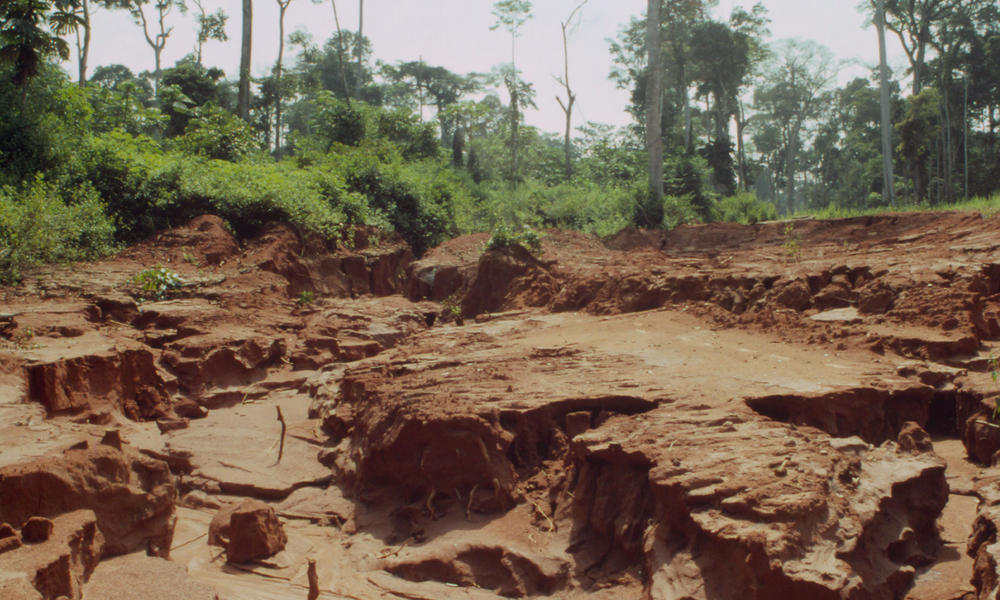
The lasting effects of torrential rain. Runoff washed away all the soil here, until the erosion reached down to the bedrock. Image by Xaume Olleros for Mongabay.
This year, Spain suffered its worst drought in almost a century. The Los Vélez region in Almería, with average precipitation of just 400 millimetres (15.7 inches) annually, didn’t receive a single drop of rain for more than 150 days. Then, in May, more than 200 mm (7.9 in) fell in a single week.
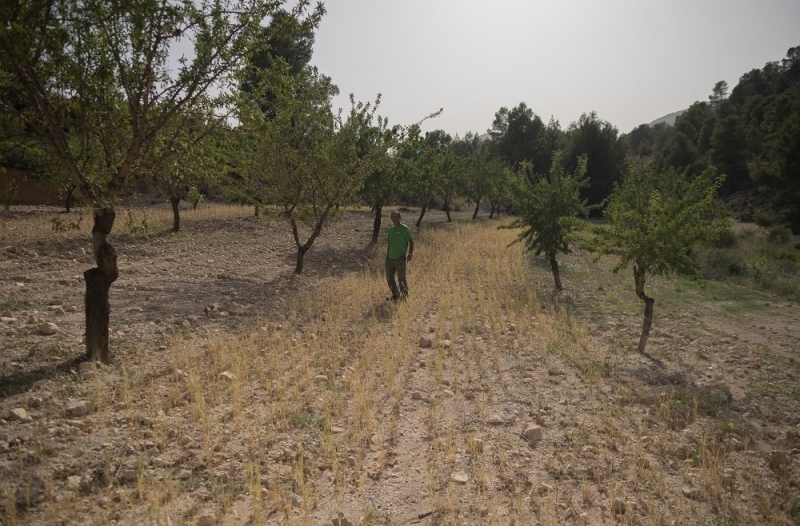
This drought-deluge cycle did serious harm to soils. In the first half of 2023, scorching sun dried up the soil, then torrential rains washed away its nutrient-rich organic matter, turning once-productive croplands into barren sand. Today, struggling groves of almond trees bear deep erosion scars caused by runoff.
But such harm isn’t seen everywhere. Santiaga Sánchez, daughter and granddaughter of shepherds, says her farm has proven more resilient than others. “It’s only now that I’ve realized the importance of the soil restoration techniques I’ve been using on my farm,” she says from her cortijo, a farmhouse, outside the small town of Chirivel.
For years, Sánchez has practiced regenerative agricultural methods: doing terrace farming, carving out swales, cultivating green cover crops under her almond trees, and increasing the soil’s capacity to absorb and retain water. This helped her trees better withstand this year’s drought and mitigate the torrential rain.
Sánchez isn’t alone. Nearly a decade ago, she and other local farmers founded Alvelal, a collaborative that includes farmers, livestock breeders, entrepreneurs, university researchers, and a variety of institutions to address current regional threats brought on by desertification, depopulation, and lack of opportunities for youth.

Erosion scars on conventional farmland caused by extreme stormwater runoff. Erosion like this can be curbed by building up organic matter via heavy mulching along with other regenerative techniques. Image by Xaume Olleros for Mongabay.
‘Prepare and adapt!’
The climate change denialism rife in the U.S. and elsewhere doesn’t seem predominant among these Iberian farmers. They’ve watched first-hand as desertification advances in Spain, consuming 1,500 square kilometres (579 square miles per year, according to Spain’s State Meteorological Agency (AEMET).
With a 1° Celsius (1.8° Fahrenheit) average temperature rise in Andalusia in southeastern Spain between 2007 and 2015, along with an average loss of fertile soil exceeding 21 metric tons per hectare per year, the region’s farmers and livestock owners are facing challenging climatic conditions.
“We have to prepare and adapt our crops, cultivation methods, and farming practices to handle potential sudden changes,” Sánchez says. “While our native animals and plants had hundreds of years to adapt in the past, climate change is now progressing rapidly.”
Well-managed soils are proving to be farmers’ best ally as they adapt to bouts of drought and deluge. They combat desertification by preventing erosion, promoting soil restoration, doing water harvesting, and encouraging biodiversity recovery — all crucial to the future of locals’ agricultural livelihoods.
Many of Alvelal’s members view agriculture as part of the broader ecosystem, where natural zones and farmlands mutually benefit each other. They nurture both natural and productive lands to create a mosaic of interconnected biodiversity hotspots. Today, ecological corridors link the region’s mountain ranges, fostering a more resilient landscape as a buffer against worsening water scarcity and rising temperatures.
Alvelal now boasts more than 250 farmer members who manage more than 15,000 hectares (37,000 acres) using regenerative agriculture. They aim to expand to 60,000 hectares (148,300 acres) of organic almond farms, employing agroecology techniques. They’ve also planted more than 260,000 trees, with the goal of restoring 25,000 hectares (nearly 62,000 acres) of natural corridor by 2034.

Santiaga Sánchez’s farm outside Chirivel, a town in the semiarid region of Los Vélez, Almería, Spain. Image by Xaume Olleros for Mongabay.
SAVE OUR SOIL = SAVE OUR SOUL!
READ ME ONCE AND READ ME TWICE AND READ ME ONCE AGAIN, IT'S BEEN A LONG, LONG TIME.