Yes trees really do talk.
Take a bracing stroll through a park or wood this weekend and you'll hear the Arctic breeze rippling through the
swaying, leafless branches, almost as if the trees are whispering to each other,
A fanciful thought, perhaps. But make no mistake, trees really do communicate.
They share nutrients, exchange warnings, nurture their young, threaten rivals and bequeath legacies, through an
incredible network of roots and fungal threads that scientists call the 'wood-wide-web'.
Now this mysterious arboreal Internet has acquired a champion in the shape of Dame Judi Dench who this week
revealed herself to be Britain's foremost celebrity nemophilist ( 'one who is fond of woodlands').
In the new BBC TV documentary, the Oscar-winning actress reveals how her passion for trees is such that over 30
years she has allowed her six-acre Surrey garden to return to woodland, where she plants saplings in remembrance of relatives, friends and fellow thespians who have died. These are trees to mark the passing of actors Natasha Richardson, Robert Hardy and Dame Judi's lasted husband, Michael Williams.
While making the programme - Judi Dench, My Passion For Trees - she spent a year working alongside Tony Kirkham, head of the arboretum at the Royal Botanic Gardens Kew, to learn more about the secret world of woodlands.
What she discovered astounded her.
"When I planted trees in memory of my friends, I always hoped they'd be part of a community - that they would be
communicating with each other", she said. It's so reassuring to find out that's true. My trees are part of an extended family".
It was in the nineties that scientists started to realise that trees are not just individuals but active members of a
vigorously chattering, mutually supportive society, not only sharing valuable resources with others of their own
species but forming networks with all comers to ensure their shared survival.
Communicating via that subterranean wood-wide-web - they are wired together by billions of gossamer-fine,
microscopically small tubes called hyphae, like fibre-optic cables that penetrate the earth, weaving through it to
connect a whole woodland or forest.
The hyphae are created by specialised fungi that grow around the trees roots and enable individual trees up to 60ft
apart to network and collaborate with each other, via, chemical and electrical impulses, in dazzling complex ways.
A spoonful of soil can hold up to seven miles of these coiled tubular threads.
Professor Suzanne Simard, an ecologist at the University of British Columbia, has studied these interactions in detail and uses the relationship between a Douglas fir tree and a Birch tree planted next to it to illustrate the mutually beneficial relationship between them.
When the birch was pulled up to give the fir more light, instead of flourishing, the fir started to fail.
Professor Simard established that the trees had developed a support system, using the fungal network to transfer
vital nutrients to each other.
In summer the birch was in full leaf, shading the young fir, it directed food in the form of carbon, nitrogen and water via the hyphae network to the fir.
In spring and autumn, the fir returned the favour when thr birch had no leaves. An awed Professor Simard said 'It might remind you of a sort of intelligence.'
Other studies indicate something still more astounding; trees acting as 'mothers' to saplings that are struggling to grow in the shade beneath high canopies.
The mother thees have been found to feed saplings of all species - yet nepotism is at work in Nature because they
give a little more food to saplings of the same species, and most food to saplings that are close relations.
Without these mother trees, attempts to regenerate forests often fail. When a mother tree is felled, the survival
rate of seedlings tends to be too much reduced.
Trees even seem to leave a sort of 'will'. When one tree is dying, it may pass on resources to neighbours of different species, feeding them and helping to ensure that the forest community stays diverse and strong. In the same way 'sick' trees are supported by the trees around them.
It's mind-blowing, a forest is a special place, every individual is sharing and passing on things to everyone else.
By John Naish for the Daily Mail 08 Dec 2017
Trees do Talk
-
Redbeck
- Site Admin
- Posts: 2147
- Joined: 19 Dec 2010 15:42
- Location: The Rookery, 3rd Horse Chestnut along, St Johns, Britain. Teacher leave our nuts alone!
- Contact:
Re: Trees do Talk
That is a brilliant set of truths to set before the community and absolutely accurate, humankind is steadily losing its interconnection with the natural world a dialogue that must be restored to sustain life on Earth and surely one that should be a key factor in any religion rather than than the extraction of yet more hydrocarbons and fossil fuels to combust and poison the atmosphere. Trees, billions of them, also provide the solution to that very problem.
In other words scientists would be better of learning to communicate with trees and isolating a cure for Acute Oak decline, Sweet Chestnut blight, Dutch Elm Disease, Chalara dieback of Ash, Horse chestnut bleeding canker, Massaria disease of Plane trees and Dothistroma needle blight of pine etc, etc rather than attempting to clean up, justify and market fracking.
Anyway here are some other interesting views on data communications at the arboritum
Biologists, ecologists, foresters, and naturalists have become increasingly convinced that trees can speak, and equally that humans can learn to tune in to this language.
According to biologist George David Haskell in his 2017 book The Songs of Trees, a significant proportion of the general populace flounder trying to come to terms with this concept, essentially because they fail to see how trees are interconnected . Connection in any type of network, Haskell argues, engenders communication and spawns languages; therefore acceptance of and understanding that nature is a network is the first stride toward hearing trees talk.
For the average citizen of our planet, who in all likelihood lives some distance from the forest, the previous observation could appear absurdly abstract. However, by way of practical guidance Haskell responds by directing his readers to the stretch of Amazon rainforest residing in Ecuador. The Waorani people who live there, see the networked character of nature and idea of communication between all living things as obvious and normal phenomena. In fact, taking the whole process a stage further, the relationships amongst trees and other life forms are consistently reflected in Waorani language.
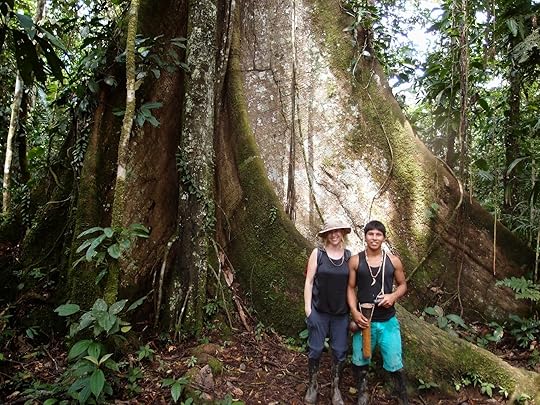
In essence spoken Waorani, describes things not only by their general heading, but also by the other beings surrounding them. Thus, for example, any individual ceibo tree isn’t just referred to as a ‘ceibo tree’ but becomes known as ‘the ivy-wrapped ceibo,’ or even more exotically, ‘the mossy ceibo with black mushrooms.’ In fact, anthropologists struggle when trying to classify and translate Waorani words into English. Haskell writes this is because, ‘when pressed by interviewers, the Waorani could not bring themselves to give individual short names for what Westerners call ‘tree species’ without including an extended ecological context such as the constituents of the surrounding vegetation.’
Because they relate to all trees in the forest as living sentient beings with intimate ties to a surrounding community of humankind and other creatures, the Waorani are not for instance horrified at the notion that felling a tree with an axe might cause it to scream when cut, or shocked that harming a tree could cause trouble for humankind. The lesson city-dwellers must take from the Waorani, Haskell continues, is that ‘dogmas of separation fragment the community of life; they wall humans in a lonely room. We must ask the question, “can we find an ethic of full earthly belonging?”’
by a giant ceiba tree

In other words scientists would be better of learning to communicate with trees and isolating a cure for Acute Oak decline, Sweet Chestnut blight, Dutch Elm Disease, Chalara dieback of Ash, Horse chestnut bleeding canker, Massaria disease of Plane trees and Dothistroma needle blight of pine etc, etc rather than attempting to clean up, justify and market fracking.
Anyway here are some other interesting views on data communications at the arboritum
Biologists, ecologists, foresters, and naturalists have become increasingly convinced that trees can speak, and equally that humans can learn to tune in to this language.
According to biologist George David Haskell in his 2017 book The Songs of Trees, a significant proportion of the general populace flounder trying to come to terms with this concept, essentially because they fail to see how trees are interconnected . Connection in any type of network, Haskell argues, engenders communication and spawns languages; therefore acceptance of and understanding that nature is a network is the first stride toward hearing trees talk.
For the average citizen of our planet, who in all likelihood lives some distance from the forest, the previous observation could appear absurdly abstract. However, by way of practical guidance Haskell responds by directing his readers to the stretch of Amazon rainforest residing in Ecuador. The Waorani people who live there, see the networked character of nature and idea of communication between all living things as obvious and normal phenomena. In fact, taking the whole process a stage further, the relationships amongst trees and other life forms are consistently reflected in Waorani language.
In essence spoken Waorani, describes things not only by their general heading, but also by the other beings surrounding them. Thus, for example, any individual ceibo tree isn’t just referred to as a ‘ceibo tree’ but becomes known as ‘the ivy-wrapped ceibo,’ or even more exotically, ‘the mossy ceibo with black mushrooms.’ In fact, anthropologists struggle when trying to classify and translate Waorani words into English. Haskell writes this is because, ‘when pressed by interviewers, the Waorani could not bring themselves to give individual short names for what Westerners call ‘tree species’ without including an extended ecological context such as the constituents of the surrounding vegetation.’
Because they relate to all trees in the forest as living sentient beings with intimate ties to a surrounding community of humankind and other creatures, the Waorani are not for instance horrified at the notion that felling a tree with an axe might cause it to scream when cut, or shocked that harming a tree could cause trouble for humankind. The lesson city-dwellers must take from the Waorani, Haskell continues, is that ‘dogmas of separation fragment the community of life; they wall humans in a lonely room. We must ask the question, “can we find an ethic of full earthly belonging?”’
by a giant ceiba tree

Re: Trees do Talk
Thanks Redbect, it's fascinating isn't it..
Who is online
Users browsing this forum: No registered users and 4 guests