Hugely interesting post Æsirs, certainly to me in terms of knowledge relative to pagan religions across the British Isles, I will therefore add a twist of northern Britain, if I may. Redbeck
Scandinavian settlers arrived in Britain in the closing decades of the ninth century, during what was known as the Late Anglo-Saxon period, bringing with them their own pre-Christian beliefs. Strangely enough, archaeologists have never identified any cultic sites as definitely used by immigrant Scandinavian pagans for worship. That said, place names do suggest some possible site examples. For instance, Roseberry Topping in North Yorkshire was known as Othensberg in the twelfth century, this a name which derived from the Old Norse Óðinsberg, or 'Hill of Óðin'. A number of place-names also contain Old Norse references to mythological entities, such as alfr, skratii, and troll. A number of pendants representing Mjolnir, the hammer of the god Thor, have also been found in England, giving rise to a more distinct probability that he was worshipped among the Anglo-Scandinavian population.
 Roseberry Topping in Yorkshire, once known as the 'Hill of Óðin'
Judith Jesch, Professor of Viking Studies at the University of Nottingham adheres to the argument that, as the only evidence uncovered thus far relates to the worship of Odin and Thor in Anglo-Scandinavian England, they might well have been the only deities actively venerated by Scandinavian settlers, even if they were aware of the mythological stories surrounding other Norse gods and goddesses. On the other hand, English studies scholar Richard North of University College London points to one passage in the Old English rune poem, written in the eighth or ninth century, which indicates knowledge of the Scandinavian god Týr.
 Gosforth Cross, view from the north west
The cross shows scenes proven as described in the
Poetic Edda.
These include images identified as:
Loki bound with his wife Sigyn protecting him.
The god Heimdallr holding his horn.
The god Víðarr tearing the jaws of Fenrir.
Thor's failed attempt to catch Jörmungandr, the Midgard Serpent.
The cross also contains Christian symbolism, including a depiction of the crucifixion of Christ. The combination of Christian and Norse pagan symbolism on the cross could perhaps be evidence of the use of pagan stories to illustrate Christian teachings.
The cross is 4.4 metres tall and made out of red sandstone. It is estimated to date from 920-950 AD and is still in fairly good condition.
 Engraving of a stone panel, showing Thor fishing
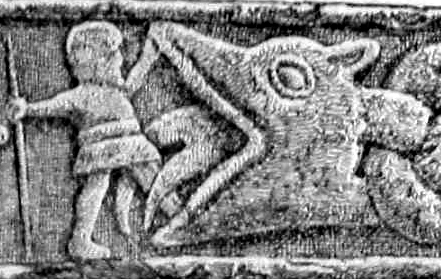 Víðarr's battle with Fenrir at Ragnarök