Page 4 of 4

Re: All Creatures Great and Small

Posted: 14 Aug 2018 22:24
by hope
IT'S A JUNGLE OUT THERE....

QUESTION if a lion takes over a pride, he kills all the Cubs? HUMANS tend to use the term 'cruel' loosely and
interpret the ways of nature in terms of our own psychology.

Nature may be 'red in the tooth and claw', as the poet Alfred Lord Tennyson put it, but only man intentionally
inflicts pain.
Yet if we look at nature in anthropomorphic terms, there are many acts that appear cruel.

We have all seen nature programmes showing a pride of lions slaughtering a zebra, a pack of wolves bringing
down a moose or a shark killing a seal or fish.
Some of the cruelest footage of recent times was featured on BBC's Bkue Planet. It was excruciating watching
a pod of killer whales chasing a grey whale mother and calf, deliberately wearing them down until the calf tired
and could be separated from its mother.

A seemingly cruel act, yet in Blue Planet II we saw an eqUally sad episode with a grieving Orca clinging to her
calf for eight days before it died.
Infanticide may seem the cruelest act of all. Yet it is a powerful evolutionary tool that has been recorded in a
number of species, including mammals, such as rodents and primates, and fish, insects and amphibians.

In the case of lions, by taking over the leadership of a pride, the new leader aims to pass on their own genetic
line.

Killing infants triggers fertility in the mother, increasing number the chance of the new male having offspring.
Infant iced is common among wild chimpanzees. Makes and females have been seen killing infants outside and
within their own communities.


image.jpeg


Scottish Daily Mail, 6th Aug 2018

Re: All Creatures Great and Small

Posted: 01 Sep 2018 11:39
by Redbeck
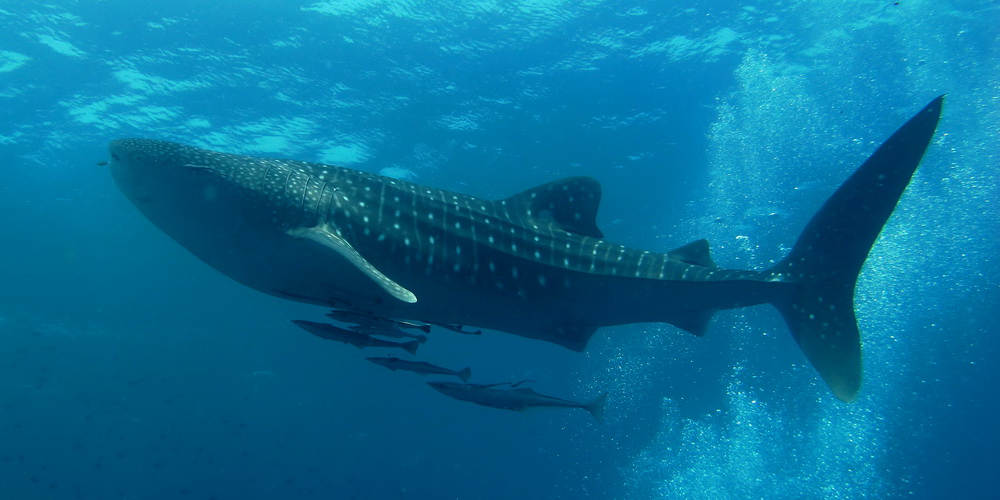
The whale shark is the largest shark and in fact the biggest fish alive today. Although there is no way of quantifying what the maximum size of this species might be, previously measured specimens evidence they can reach the average length of a school bus [45 feet (13.7 metres).

These gentle marine giants roam across the tropical oceans of the world, generally alone. Nevertheless, large numbers of whale sharks are frequently sighted gathering in areas abundant with plankton - where they become prime tourist attractions. Plankton is the small and microscopic organisms drifting or floating either in the sea or fresh water, consisting predominantly of diatoms, protozoans, small crustaceans, along with the eggs and larval stages of larger animals. Because whale sharks feed on plankton, they are prepared to travel large distances to locate sufficient food to sustain their huge size, and to reproduce.

Their white spotted colouration makes these gentle giants easy to distinguish, and are popular with snorkelers and divers at sites where they gather off the coast.

Sadly, like an alarming number of other beloved creatures on planet Earth today the whale shark is facing huge challenges.

These majestic creatures, now classified as an IUCN endangered species, are at risk from being caught as bycatch and struck by ships, and are still hunted in some parts of the world for their fins and meat. Bycatch is the term used for the unwanted fish and other marine creatures trapped by commercial fishing nets during fishing for a different species, often thrown back into the sea dead.

Poorly managed whale shark tourism also presents a threat to the species as it may interrupt their feeding and sharks can be injured by boat propellers, highlighting the importance of responsible tourism practices.

The message, it is important to save every creature on this planet, why are we worrying about the rights and wrongs of strong arm politics, predatory territorial gain, abuses of financial power and abusive journalism based on questionable facts when the real truth is humankind’s lifeline, the natural world about us is dying. All the old soap box political and social change freedoms and causes we embraced so vigorously in different times have become totally irrelevant, when faced by the ravaging effects of pollution of air, land and sea and swingeing climate change. If we are not prepared to roll up our sleeves in determined fashion and work most diligently to help conserve and restore the natural resources vital to the longevity of the Earth, consequently our lives and that of our fellow creatures upon it, to some form of healthy balance, then quite simply future generations are doomed anyway. There are increasing numbers among us blessed with the same inate sense of goodness, driving the notion to share resources under a fairer system across our world in the future, but we must save and sustain them first. This is the project that should figure highest on humankind's agenda.


Image

Re: All Creatures Great and Small

Posted: 06 Oct 2018 15:32
by hope
Female hyenas are ruled by a matriarchy. How does this work?
Are there other matriarchies in mature?

The social structure of the spotted hyena (Crocuta Crocuta), also known as the laughing hyena, is unusual in that
every clan is ruled by an alpha female.
The hyena is a highly successful animal, being the most common large carnivore in Africa. It's highly adaptable: it
will hunt but also scavenge, and has the ability to eat and digest skin and bone.

Larger and more aggressive than the males, it's the spotted hyena females that dominate their social groups, each
of which may have up to 80 members.
The clans have a strict power structure with the adult males at the bottom. When feeding on a communal carcass,
the adult males eat last. When a male kills, he must gorge quickly before the female clan members shove him aside.


Image


In most species, males battle it out for sexual dominance. Male hyenas first battle to enter the clan, then live a life
of subservience until they're accepted by a female after one of two years.
This process is known as endurance rivalry, where the male willing to take the most abuse gets to mate.
A highly unusual aspect of female hyena physiology is that their genitals, despite their totally different functions, so
closely resemble those of a male that it hard to tell them apart.
Dues to this, for centuries hyenas were suspected of being hermaphrodites and witches steeds or were-beasts.

Anne Gillingham, Salisbury, Wilts. MATrI -Archles are common in nature than you might suppose. The social structure
of a beehive is that of a matriarchal family headed by an all powerful queen.
Other animals with this matriarch system are elephants and killer whale pods are based on the linage of the mother,
sons and daughters travel with their mothers even after they are fully grown, forming strongly matriarchal
societies.


Answers to corespondents by Charles Legge
daily Mail 5th, September 2018

Re: All Creatures Great and Small

Posted: 22 Sep 2023 23:02
by Redbeck
Another example of a highly sophisticated member of the Coleoptera eco-chain in our majestic natural world - the Bombardier beetle.

Beetles are insects and form the collective order known as Coleoptera, [derived from the Greek words koleon (sheath) and pteron (wing)] they reside within the superorder Endopterygota. The Coleoptera, contains around 400,000 catalogued species, new species are regularly discovered and the estimated number of species is probably well over a million. It is the largest of all the collective orders, comprising almost 40% of all catalogued insects and 25% of all known animal species. Beetles have been prominent in human culture for at least 5 millennia, taking the sacred scarabs of ancient Egypt as a prime example


Image

Bombardier beetles are ground beetles (Carabidae) in the tribes Brachinini, Paussini, Ozaenini, or Metriini, a collective that encompasses more than 500 species altogether.

They are most notable for what is a highly developed defence mechanism from which their name originated. When disturbed by a deemed aggressor, they release a searing toxic chemical spray from the tip of the abdomen with a popping sound.

Analysis of this advanced noxious spray, determines that is produced by a reaction between two hypergolic chemical compounds, hydroquinone and hydrogen peroxide, stored in two reservoirs in the beetle's abdomen. When the aqueous solution of hydroquinones and hydrogen peroxide reaches the "vestibule" (a term coined by Thomas Eisner a German-American entomologist and ecologist, known as the "father of chemical ecology."), complex catalysts facilitate the decomposition of the hydrogen peroxide and the oxidation of the hydroquinone. Heat generated by this reaction brings the mixture close to the boiling point of water and produces a gas that propels the release. The resultant damage caused to attacking insects can often be fatal . Some species of bombardier beetles can direct the spray at targets coming from a wide in a wide spread of directions.

The Bombardier beetle is found on all the continents in the world except Antarctica, a fundamental brick in the eco-system, they are carnivorous including larvae. Typical habitats are woodlands or grasslands in more temperate zones, but may also be found in other environments where there are moist places in which to lay their eggs.

The beetle's extraordinary defence mechanism is claimed by some neo-creationists of the intelligent design movement to be an example of what they call irreducible complexity which is refuted by evolutionary biologists.

Irreducible complexity (IC) embraces the argument that as any number of biological systems composed of multiple interacting parts would fail to function if one of the parts were removed, then evolution as as result of successive small modifications to earlier less complex systems through natural selection is neither practical nor feasible. Presenting an alternative explanation that complex biological systems are in fact a "purposeful arrangement of parts" that infers design by a creative intelligence present in all life forms on Earth governed by a higher plane of ‘natural’ consciousness, a resource, from which we as humans have become increasingly disconnected as millennia have unfolded. Our increasing lack of connectivity with spirituality and the natural world around us has denuded our understanding of the networks of intelligence that pervade the functionality of that natural world.

The intelligent design movement is a neo-creationist campaign for broad social, academic and political change and stimulates support for the quasi-scientific idea of intelligent design (ID), which argues that "certain features of the universe and of living things are better explained by an intelligent cause, not an undirected process such as natural selection."

The ID movement goal is to diminish and ultimately change the prevailing materialistic world view. To this end, advocates of intelligent design adopt a two-path approach. In tandem with the promotion of intelligent design, exponent groups also contest the traditional theory of evolution by highlighting perceived flaws in the theory itself. They disagree with many views held within the scientific community and encourage tutors and students to explore non-scientific alternatives to evolution, or at least to critically analyse evolution and what they refer to as ‘The Controversy’ surrounding the teaching of evolution.

So what are your thoughts on the Bombardier Beetle, a natural defence engineer and beneficiary of the inherent creative intelligence resident in all creatures from across the universe or a mere soldier of fortune mysteriously blessed by multiple stages of selective evolution to address changing environment and existential threats??

Kind Regards Redbeck

Re: All Creatures Great and Small

Posted: 26 Sep 2023 21:39
by Redbeck
A CONTINUATION FROM THE POST ABOVE AND A SUPPORTING EXPANSION ON THE SUBJECT OF UNVERSAL CREATIVE INTELLIGENCE


http://www.973-eht-namuh-973.com/Alchem ... 202295.htm


BOMBARDIER BEETLE


LIFE THE CREATIVE METAMORPHOSIS
Post by Redbeck » 22 Sep 2023 23:10

Bombardier beetles are ground beetles (Carabidae) in the tribes Brachinini, Paussini, Ozaenini, or Metriini, a collective that encompasses more than 500 species altogether.

They are most notable for what is a highly developed defence mechanism from which their name originated. When disturbed by a deemed aggressor, they release a searing toxic chemical spray from the tip of the abdomen with a popping sound.

Analysis of this advanced noxious spray, determines that is produced by a reaction between two hypergolic chemical compounds, hydroquinone and hydrogen peroxide, stored in two reservoirs in the beetle's abdomen. When the aqueous solution of hydroquinones and hydrogen peroxide reaches the "vestibule" (a term coined by Thomas Eisner a German-American entomologist and ecologist, known as the "father of chemical ecology."), complex catalysts facilitate the decomposition of the hydrogen peroxide and the oxidation of the hydroquinone. Heat generated by this reaction brings the mixture close to the boiling point of water and produces a gas that propels the release. The resultant damage caused to attacking insects can often be fatal . Some species of bombardier beetles can direct the spray at targets coming from a wide in a wide spread of directions.

The Bombardier beetle is found on all the continents in the world except Antarctica, a fundamental brick in the eco-system, they are carnivorous including larvae. Typical habitats are woodlands or grasslands in more temperate zones, but may also be found in other environments where there are moist places in which to lay their eggs.

The beetle's extraordinary defence mechanism is claimed by some neo-creationists of the intelligent design movement to be an example of what they call irreducible complexity which is refuted by evolutionary biologists.

Irreducible complexity (IC) embraces the argument that as any number of biological systems composed of multiple interacting parts would fail to function if one of the parts were removed, then evolution as as result of successive small modifications to earlier less complex systems through natural selection is neither practical nor feasible. Presenting an alternative explanation that complex biological systems are in fact a "purposeful arrangement of parts" that infers design by a creative intelligence present in all life forms on Earth governed by a higher plane of ‘natural’ consciousness, a resource, from which we as humans have become increasingly disconnected as millennia have unfolded. Our increasing lack of connectivity with spirituality and the natural world around us has denuded our understanding of the networks of intelligence that pervade the functionality of that natural world.

The intelligent design movement is a neo-creationist campaign for broad social, academic and political change and stimulates support for the quasi-scientific idea of intelligent design (ID), which argues that "certain features of the universe and of living things are better explained by an intelligent cause, not an undirected process such as natural selection."

The ID movement goal is to diminish and ultimately change the prevailing materialistic world view. To this end, advocates of intelligent design adopt a two-path approach. In tandem with the promotion of intelligent design, exponent groups also contest the traditional theory of evolution by highlighting perceived flaws in the theory itself. They disagree with many views held within the scientific community and encourage tutors and students to explore non-scientific alternatives to evolution, or at least to critically analyse evolution and what they refer to as ‘The Controversy’ surrounding the teaching of evolution.

So what are your thoughts on the Bombardier Beetle, a natural defence engineer and beneficiary of the inherent creative intelligence resident in all creatures from across the universe or a mere soldier of fortune mysteriously blessed by multiple stages of selective evolution to address changing environment and existential threats??


EXTRACT

The beetle's extraordinary defence mechanism is claimed by some neo-creationists of the intelligent design movement to be an example of what they call irreducible complexity which is refuted by evolutionary biologists.

Irreducible complexity (IC) embraces the argument that as any number of biological systems composed of multiple interacting parts would fail to function if one of the parts were removed, then evolution as as result of successive small modifications to earlier less complex systems through natural selection is neither practical nor feasible. Presenting an alternative explanation that complex biological systems are in fact a "purposeful arrangement of parts" that infers design by a creative intelligence present in all life forms on Earth governed by a higher plane of ‘natural’ consciousness, a resource, from which we as humans have become increasingly disconnected as millennia have unfolded. Our increasing lack of connectivity with spirituality and the natural world around us has denuded our understanding of the networks of intelligence that pervade the functionality of that natural world.


But the best-known bombardier beetles are those that deploy explosions to defend themselves. With an audible pop, these beetles spray a concoction of boiling, irritating chemicals at predators that get too close. The beetles have plenty of ammo and can rapidly fire their chemicals over and over again.

FURTHER MATERIAL

How some beetles produce a scalding defensive spray

MIT News

https://news.mit.edu › how-bombardier-beetles-produc...
bombardier beetle defence mechanism from news.mit.edu
30 Apr 2015 — Bombardier beetles eject a liquid called benzoquinone, which they superheat and expel in an intense, pulsating jet. The explosive mechanism used ...

How some beetles produce a scalding defensive spray
New analysis shows how bombardier beetles produce an explosive defensive chemical jet.
Watch Video
David L. Chandler | MIT News Office
Publication Date: April 30, 2015


Image


Bombardier beetles, which exist on every continent except Antarctica, have a pretty easy life. Virtually no other animals prey on them, because of one particularly effective defence mechanism: When disturbed or attacked, the beetles produce an internal chemical explosion in their abdomen and then expel a jet of boiling, irritating liquid toward their attackers.

Researchers had been baffled by the half-inch beetles’ ability to produce this noxious spray while avoiding any physical damage. But now that conundrum has been solved, thanks to research by a team at MIT, the University of Arizona, and Brookhaven National Laboratory. The findings are published this week in the journal Science by MIT graduate student Eric Arndt, professor of materials science and engineering Christine Ortiz, Wah-Keat Lee of Brookhaven National Laboratory, and Wendy Moore of the University of Arizona.

“Their defensive mechanism is highly effective,” Arndt says, making bombardier beetles “invulnerable to most vertebrates, and invertebrates” — except for a few very specialized predators that have developed countermeasures against the noxious spray.

The liquid these beetles eject is called benzoquinone, and is actually a fairly common defensive agent among insects, Arndt says. But bombardier beetles are unique in their ability to superheat the liquid and expel it in an intense, pulsating jet.

The key is that they synthesize the chemical at the instant of use, mixing two chemical precursors in a protective chamber in their hindquarters. As the materials combine to form the irritant, they also give off intense heat that brings the liquid almost to the boiling point — and, in the process, generates the pressure needed to expel it in a jet.

Learn how bombardier beetles detonate small explosions in their bodies to produce a scalding defensive spray.

Seeing inside a living beetle
“For decades, the complex mechanism of how the bombardier beetle achieves spray pulsation as a chemical defense has not been understood, because only external observations were used previously,” Ortiz says. In the current study, the researchers used high-speed synchrotron X-ray imaging to “see” inside the abdomens of living bombardier beetles during explosions. They used a facility at Argonne National Laboratory to carry out the experiments and produce detailed images that revealed, for the first time, how the process works, with a camera recording the action at a rate of 2,000 frames per second.

The X-ray images of the explosion reveal the dynamics of vapor inside the beetles’ abdomens. They show that spray pulsation is controlled by the passageway between two internal chambers; two structures control this process: a flexible membrane and a valve.

The opening and closing of this passageway between a chamber holding the precursor liquid and an explosion chamber seems to take place passively; an increase in pressure during the explosion expands the membrane, closing the valve. Then, after the pressure is released when the liquid is ejected, the membrane relaxes back to its original state and the passage reopens, allowing the next pulse to form. This all takes place so rapidly — not to mention inside the insect — that the process had never been directly observed.

The explosive mechanism used by the bombardier beetle generates a spray that is not only much hotter than that emitted by other insects that use the same chemical irritant, but also propels the jet five times faster. Both the speed and the heat serve to make the spray even more effective against potential predators, Arndt says.

The pulsing nature of the spray may help protect the structure of the beetle’s reaction chamber, Arndt says, allowing time for the chamber walls to cool a bit before the next pulse.

Understanding the beetles’ ability to survive these intense internal explosions may help in designing blast-protection systems; this study shows how the sophisticated and specialized biological design of the system works to simultaneously achieve defensive and protective functions, Ortiz says. The reaction chamber, for example, possesses a rigid, reinforcing structure to minimize stretching and sustain temperature increases during an explosion, while other components allow for controlled, reversible stretching and movement to control the jet of fluid. The dynamics of the spray generation might also provide information useful in the design of propulsion systems, the researchers say.

R. Jeffrey Dean, a professor of biology at Cleveland State University who studies the defense mechanisms of the bombardier beetle, says the new work is a “wonderful confirmation of the qualitative passive ‘pulse jet’ model” first proposed by his team. “Although the findings are not unexpected, I’m amazed at the progressive advances in techniques,” he adds.

This research was supported by the Department of Energy, the Department of Defense through the U.S. Army Research Office and the National Security Science and Engineering Faculty Fellowship, and the National Science Foundation.


INVENTION OF HUMAN PROPULSION SYSTEMS

Global web icon
NASA

https://www.grc.nasa.gov/www/k-12/TRC/R ... ckets.html
Brief History of Rockets - NASA Web

The Chinese began experimenting with the gunpowder-filled tubes. At some point, they attached bamboo tubes to arrows and launched them with bows. Soon they discovered that these gunpowder tubes could launch themselves just by the power produced from the escaping gas.

Brief History of Rockets
Today's rockets are remarkable collections of human ingenuity that have their roots in the science and technology of the past. They are natural outgrowths of literally thousands of years of experimentation and research on rockets and rocket propulsion.

One of the first devices to successfully employ the principles essential to rocket flight was a wooden bird. The writings of Aulus Gellius, a Roman, tell a story of a Greek named Archytas who lived in the city of Tarentum, now a part of southern Italy. Somewhere around the year 400 B.C., Archytas mystified and amused the citizens of Tarentum by flying a pigeon made of wood. Escaping steam propelled the bird suspended on wires. The pigeon used the action-reaction principle, which was not stated as a scientific law until the 17th century.

About three hundred years after the pigeon, another Greek, Hero of Alexandria, invented a similar rocket-like device called an aeolipile. It, too, used steam as a propulsive gas.

Hero mounted a sphere on top of a water kettle. A fire below the kettle turned the water into steam, and the gas travelLed through pipes to the sphere. Two L-shaped tubes on opposite sides of the sphere allowed the gas to escape, and in doing so gave a thrust to the sphere that caused it to rotate.

Just when the first true rockets appeared is unclear. Stories of early rocket like devices appear sporadically through the historical records of various cultures. Perhaps the first true rockets were accidents. In the first century A.D., the Chinese reportedly had a simple form of gunpowder made from saltpeter, sulfur, and charcoal dust. To create explosions during religIous festivals, they filled bamboo tubes with a mixture and tossed them into fires. Perhaps some of those tubes failed to explode and instead skittered out of the fires, propelled by the gases and sparks produced by the burning gunpowder.


The Chinese began experimenting with the gunpowder-filled tubes. At some point, they attached bamboo tubes to arrows and launched them with bows. Soon they discovered that these gunpowder tubes could launch themselves just by the power produced from the escaping gas. The true rocket was born.

The date reporting the first use of true rockets was in 1232. At this time, the Chinese and the Mongols were at war with each other. During the battle of Kai-Keng, the Chinese repelled the Mongol invaders by a barrage of "arrows of flying fire." These fire-arrows were a simple form of a solid-propellant rocket. A tube, capped at one end, contained gunpowder. The other end was left open and the tube was attached to a long stick. When the powder was ignited, the rapid burning of the powder produced fire, smoke, and gas that escaped out the open end and produced a thrust. The stick acted as a simple guidance system that kept the rocket headed in one general direction as it flew through the air. It is not clear how effective these arrows of flying fire were as weapons of destruction, but their psychological effects on the Mongols must have been formidable.

Following the battle of Kai-Keng, the Mongols produced rockets of their own and may have been responsible for the spread of rockets to Europe. All through the 13th to the 15th centuries there were reports of many rocket experiments. In England, a monk named Roger Bacon worked on improved forms of gunpowder that greatly increased the range of rockets. In France, Jean Froissart found that more accurate flights could be achieved by launching rockets through tubes. Froissart's idea was the forerunner of the modern bazooka. Joanes de Fontana of Italy designed a surface-running rocket-powered torpedo for setting enemy ships on fire.


By the 16th century rockets fell into a time of disuse as weapons of war, though they were still used for fireworks displays, and a German fireworks maker, Johann Schmidlap, invented the "step rocket," a multi-staged vehicle for lifting fireworks to higher altitudes. A large sky rocket (first stage) carried a smaller sky rocket (second stage). When the large rocket burned out, the smaller one continued to a higher altitude before showering the sky with glowing cinders. Schmidlap's idea is basic to all rockets today that go into outer space.

Nearly all uses of rockets up to this time were for warfare or fireworks, but there is an interesting old Chinese legend that reported the use of rockets as a means of transportation. With the help of many assistants, a lesser-known Chinese official named Wan-Hu assembled a rocket- powered flying chair. Attached to the chair were two large kites, and fixed to the kites were forty- seven fire-arrow rockets.

On the day of the flight, Wan-Hu sat himself on the chair and gave the command to light the rockets. Forty-seven rocket assistants, each armed with torches, rushed forward to light the fuses. In a moment, there was a tremendous roar accompanied by billowing clouds of smoke. When the smoke cleared, Wan-Hu and his flying chair were gone. No one knows for sure what happened to Wan-Hu, but it is probable that if the event really did take place, Wan-Hu and his chair were blown to pieces. Fire-arrows were as apt to explode as to fly.

Rocketry Becomes a Science
During the latter part of the 17th century, the scientific foundations for modern rocketry were laid by the great English scientist Sir Isaac Newton (1642-1727). Newton organized his understanding of physical motion into three scientific laws. The laws explain how rockets work and why they are able to work in the vacuum of outer space. Newton's laws soon began to have a practical impact on the design of rockets. About 1720, a Dutch professor, Willem Gravesande, built model cars propelled by jets of steam. Rocket experimenters in Germany and Russia

began working with rockets with a mass of more than 45 kilograms. Some of these rockets were so powerful that their escaping exhaust flames bored deep holes in the ground even before lift-off.

During the end of the 18th century and early into the 19th, rockets experienced a brief revival as a weapon of war. The success of Indian rocket barrages against the British in 1792 and again in 1799 caught the interest of an artillery expert, Colonel William Congreve. Congreve set out to design rockets for use by the British military.

The Congreve rockets were highly successful in battle. Used by British ships to pound Fort McHenry in the War of 1812, they inspired Francis Scott Key to write "the rockets' red glare," words in his poem that later became The Star- Spangled Banner.

Even with Congreve's work, the accuracy of rockets still had not improved much from the early days. The devastating nature of war rockets was not their accuracy or power, but their numbers. During a typical siege, thousands of them might be fired at the enemy. All over the world, rocket researchers experimented with ways to improve accuracy. An Englishman, William Hale, developed a technique called spin stabilization. In this method, the escaping exhaust gases struck small vanes at the bottom of the rocket, causing it to spin much as a bullet does in flight. Variations of the principle are still used today.

Rockets continued to be used with success in battles all over the European continent. However, in a war with Prussia, the Austrian rocket brigades met their match against newly designed artillery pieces. Breech-loading cannon with rifled barrels and exploding warheads were far more effective weapons of war than the best rockets. Once again, rockets were relegated to peacetime uses.

Modern Rocketry Begins
In 1898, a Russian schoolteacher, Konstantin Tsiolkovsky (1857-1935), proposed the idea of space exploration by rocket. In a report he published in 1903, Tsiolkovsky suggested the use of liquid propellants for rockets in order to achieve greater range. Tsiolkovsky stated that the speed and range of a rocket were limited only by the exhaust velocity of escaping gases. For his ideas, careful research, and great vision, Tsiolkovsky has been called the father of modern astronautics.

Early in the 20th century, an American, Robert H. Goddard (1882-1945), conducted practical experiments in rocketry. He had become interested in a way of achieving higher altitudes than were possible for lighter-than-air balloons. He published a pamphlet in 1919 entitled A Method of Reaching Extreme Altitudes. It was a mathematical analysis of what is today called the meteorological sounding rocket.

Goddard's earliest experiments were with solid-propellant rockets. In 1915, he began to try various types of solid fuels and to measure the exhaust velocities of the burning gases. While working on solid-propellant rockets, Goddard became convinced that a rocket could be propelled better by liquid fuel. No one had ever built a successful liquid-propellant rocket before. It was a much more difficult task than building solid- propellant rockets. Fuel and oxygen tanks, turbines, and combustion chambers would be needed. In spite of the difficulties, Goddard achieved the first successful flight with a liquid- propellant rocket on March 16, 1926. Fuelled by liquid oxygen and gasoline, the rocket flew for only two and a half seconds, climbed 12.5 meters, and landed 56 meters away in a cabbage patch. By today's standards, the flight was unimpressive, but like the first powered airplane flight by the Wright brothers in 1903, Goddard's gasoline rocket was the forerunner of a whole new era in rocket flight.

Goddard's experiments in liquid-propellant rockets continued for many years. His rockets became bigger and flew higher. He developed a gyroscope system for flight control and a payload compartment for scientific instruments. Parachute recovery systems were employed to return rockets and instruments safely. Goddard, for his achievements, has been called the father of modern rocketry.

A third great space pioneer, Hermann Oberth (1894-1989) born on June 25, 1894 in Hermannstadt (Transylvania), and died on December 28, 1989 in Nuremberg, Germany, published a book in 1923 about rocket travel into outer space. His writings were important. Because of them, many small rocket societies sprang up around the world. In Germany, the formation of one such society, the Verein fur Raumschiffahrt (Society for Space Travel), led to the development of the V-2 rocket, which was used against London during World War II. In 1937, German engineers and scientists, including Oberth, assembled in Peenemunde on the shores of the Baltic Sea. There the most advanced rocket of its time would be built and flown under the directorship of Wernher von Braun.


The V-2 rocket (in Germany called the A-4) was small by comparison to today's rockets. It achieved its great thrust by burning a mixture of liquid oxygen and alcohol at a rate of about one ton every seven seconds. Once launched, the V-2 was a formidable weapon that could devastate whole city blocks.

Fortunately for London and the Allied forces, the V-2 came too late in the war to change its outcome. Nevertheless, by war's end, German rocket scientists and engineers had already laid plans for advanced missiles capable of spanning the Atlantic Ocean and landing in the United States. These missiles would have had winged upper stages but very small payload capacities.

With the fall of Germany, many unused V-2 rockets and components were captured by the Allies. Many German rocket scientists came to the United States. Others went to the Soviet Union. The German scientists, including Wernher von Braun, were amazed at the progress Goddard had made.

Both the United States and the Soviet Union realized the potential of rocketry as a military weapon and began a variety of experimental programs. At first, the United States began a program with high-altitude atmospheric sounding rockets, one of Goddard's early ideas. Later, a variety of medium- and long-range intercontinental ballistic missiles were developed. These became the starting point of the U.S. space program. Missiles such as the Redstone, Atlas, and Titan would eventually launch astronauts into space.

On October 4, 1957, the world was stunned by the news of an Earth-orbiting artificial satellite launched by the Soviet Union. Called Sputnik I, the satellite was the first successful entry in a race for space between the two superpower nations. Less than a month later, the Soviets followed with the launch of a satellite carrying a dog named Laika on board. Laika survived in space for seven days before being put to sleep before the oxygen supply ran out.

A few months after the first Sputnik, the United States followed the Soviet Union with a satellite of its own. Explorer I was launched by the U.S. Army on January 31, 1958. In October of that year, the United States formally organized its space program by creating the National Aeronautics and Space Administration (NASA). NASA became a civilian agency with the goal of peaceful exploration of space for the benefit of all humankind.

Soon, many people and machines were being launched into space. Astronauts orbited Earth and landed on the Moon. Robot spacecraft travelled to the planets. Space was suddenly opened up to exploration and commercial exploitation. Satellites enabled scientists to investigate our world, forecast the weather, and to communicate instantaneously around the globe. As the demand for more and larger payloads increased, a wide array of powerful and versatile rockets had to be built.

Since the earliest days of discovery and experimentation, rockets have evolved from simple gunpowder devices into giant vehicles capable of traveling into outer space. Rockets have opened the universe to direct exploration by humankind.

Additional examples of human/biological propulsion systems are: spitting long distances, the male act of ejaculation and another amazing creature, the Archerfish who shoots down its prey!

The Archerfish, hailed as the 'anti-aircraft gunner' of the aquatic world, enjoys such unerring eyesight and precise control that it can shoot down flying insects by spitting out a jet of water. They can bring down insects and other prey up to 3 m (10 ft) above the water's surface and are also able to make split second adjustments in trajectory to compensate for the refraction of light as the water jet passes through the air-water interface whilst aiming at their prey.


SINCE THE EARLIESTOF DISCOVERY AND EXPERIMENTATION, ROCKETS HAVE EVOLVEDFROM SIMPLE DEVICES

GUNPOWDER INTO GIANT VEHICLES CAPABLE OF TRAVELING INTO OUTER SPACE.

ROCKETS HAVE OPENED THE UNIVERSE TO DIRECT EXPLORATION BY HUMANKIND.


Image

Re: All Creatures Great and Small

Posted: 27 Sep 2023 01:03
by tempocharm
This little rodent

Image
Wtf


thankyou