Page 1 of 1

Abraxas

Posted: 12 Feb 2019 00:32
by Sh3rl0ck
Greetings to you all!

I'm not sure how many of you are familiar with the term/name abraxas. I just recently read about this mystical gnostic warrior that many religions represented as god in the past.
Here's a link for more information on it:

https://www.google.com/amp/s/gnosticwar ... s.html/amp

Abraxas reminded me of some of subjects mentioned in the human.

There are 7 letters in abraxas name, representing the seven planets. He is also represented as Jupiter, king of all the planets, and rules the number 365 which is the number of days that the planet Jupiter rules over the heavenly gods.

Jupiter also is the king of AS ABOVE and SO BELOW, which is mentioned in the human as well.

"Abraxas is the ancient term of what we call today the pagan movement and even various other religions like Christianity and Judaism. According to the gnostic principles, the number 365 and the seven letters of the name abraxas correspond to the seven rays of the planetary speheres in which he is king of the heavens and earth."

"The original gnostic religion of abraxas has its roots in the ancient Egyptian new kingdom located at Thebes. It was here where they had proclaimed jupiter to be the supreme ruler of both the AS ABOVE and SO BELOW, in which they had subscribed seven subordinate angels (planets). The meaning of Thebes is from the word theba that signifies 'ark'. The capitol of the religion of the city of light of what we know of as Luxor, where they had worshipped god Amon-Ra (Jupiter-Amon)."

Here are some more links on the gnostic warrior and many ancient symbols of abraxas:

https://en.m.wikipedia.org/wiki/Abraxas

https://www.dictionary.com/browse/abraxas

https://mythology.net/greek/greek-concepts/abraxas/

https://www.google.com/amp/s/amp.reddit ... s_it_good/

Back in archaic times, abraxas was thought to be a god. Nowadays people have controversies of deciding whether or not he was a god or a demon.

Also something I think you would all find interesting is that abraxas other name is abracadabra. Sounds familiar?
I suggest reading up on him. It is quite in fact interesting in what information is on him, and there are many similarities to 973 eht namuh.
IMG_1872.JPG

Re: Abraxas

Posted: 12 Feb 2019 10:37
by Koguntetsu
abraxas.png
(8.8 KiB) Downloaded 484 times

Re: Abraxas

Posted: 12 Feb 2019 10:40
by Koguntetsu
abraxas2.png
(4.57 KiB) Downloaded 482 times

Re: Abraxas

Posted: 17 Feb 2019 16:22
by Redbeck
Greetings Sh3rl0ck, reiterated thanks for your continued post productivity and not forgetting Koguntetsu in your ongoing development of interesting themes from those posts as well as your own. Also Sh3rl0ck I am not able to respond to private messages because of a technical fault which appears to affect just me. Regards Redbeck

Abraxas (Greek: variant form Abrasax) is a word of mystic meaning in the system of the Gnostic Basilides, used relative to the "Great Archon" (Greek: megas archon), the princeps of the 365 spheres (Greek: ouranoi).

Gnosticism (Ancient Greek: gnostikos, "having knowledge") is a modern nomenclature for a variety of ancient religious ideas and systems, originating in the closely intermingled Jewish-Christian sociocultural environment that existed in the first and second century AD. Basilides was an early Christian Gnostic religious teacher in Alexandria, Egypt who taught from 117 to 138 AD, and claimed to have inherited his teachings from the Apostle Saint Matthias. Matthias, who died circa 80 AD, according to the Acts of the Apostles, was the apostle chosen to replace Judas Iscariot following his betrayal of Jesus and Judas' subsequent death.


Image

A print from Bernard de Montfaucon's L'antiquité expliquée et représentée en figures (Band 2,2 page 358 ff plaque 144) with different images of Abraxas

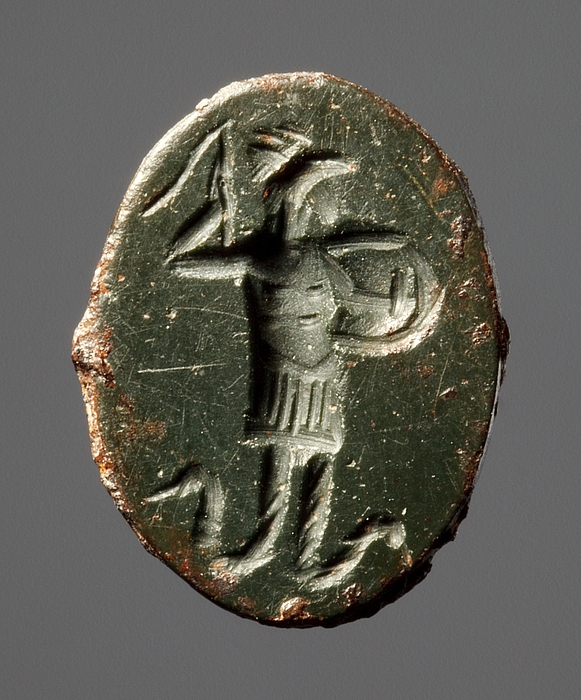
The word Abraxas is found in Gnostic texts such as the Holy Book of the Great Invisible Spirit, also informally entitled the Coptic Gospel of the Egyptians (which is a quite distinct work from the Greek Gospel of the Egyptians)and also appears in the Greek Magical Papyri. It was engraved on certain antique gemstones, which resulted in them becoming known as 'Abraxas stones', and were objects employed as amulets or charms.

Image

Amulets and seals bearing the figure of Abraxas were popular in the 2nd century, and were also displayed in the 13th century in some of the seals of the devout Knights Templar. Despite all the connotations for good Abraxas had by the medieval era been demoted to demon status. I exercise my entitlement to form a completely different opinion, as many leaders, nations and factions in the modern world appear to be exhibiting the same savage behavioural barbarism as if humankind were still in walking that Medieval earth. In this context Abraxas comes across as a thoroughly good person.

As the initial spelling on stones was "Abrasax", the spelling of "Abraxas" seen today which likely originates from the confusion between the Greek letters Sigma and Xi in the Latin transliteration. The seven letters spelling its name may represent each of the seven classic planets. There is a school of research which believes that the word may be related to Abracadabra, although that is perhaps the most romantic among other explanations that exist.

There are similarities and differences between such figures in reports about Basilides's teaching, ancient Gnostic texts, the larger Greco-Roman magical traditions, massively important in the development of mainstream Christian and Jewish faiths, as well as modern magical and esoteric writings. During the past 150 years speculation on the nature of Abraxas has proliferated, with claim and counterclaim that mythology relates to both an Egyptian god and a demon.

973-eht-namuh-973.com’s prominent number and numeric patterns extraction aspect, is also contained in the scholarly descriptive definitions of Abraxas.

Abraxas as an Archon (a Greek word that means one of the nine chief magistrates of ancient Athens, circa1650s, from Greek arkhon "ruler, commander, chief, captain,"). The name occurs in the Refutation of all Heresies (vii. 26) by Hippolytus, who appears in these chapters to have followed the Exegetica of Basilides. After describing the manifestation of the Gospel in the Ogdoad and Hebdomad, Hyppolitis adds that the Basilidians embrace a long account of the innumerable creations and powers in the several 'stages' of the upper world (diastemata), in which they speak of 365 heavens and say that "their great archon" is Abrasax, because his name contains the number 365, the number of the days in the year; i.e. the sum of the numbers denoted by the Greek alphabet letters used to spell the Latin alphabet version ABRASAX according to the rules of isopsephy (The practice of adding up the number values of the letters in a word to form a single number) is 365.

An archon, in the Gnosticism of late antiquity, described any one of several servants of the Demiurge, the "creator god" that stood between the human race and a transcendent God that could only be reached through gnosis (knowledge and learning). An ideology which I have to say has appealed to me in later years, learning to that leads to doing good aamong humankind.

Abraxas as a god: Epiphanius bishop of Salamis, who appears to partially follow Irenaeus, partly the lost Compendium of Hippolytus, affords Abraxas greater distinction as "the power above all, and First Principle," "the cause and first archetype" of all things; and mentions that the Basilidians referred to 365 as the number of parts (mele) in the human body, as well as of days in the year.

Abraxas as an Aeon: Aeon a power existing from eternity; an emanation or phase of the supreme deity. Here there is a lack of clarity. The Holy Book of the Great Invisible Spirit, for instance, refers to Abrasax as an Aeon dwelling with Sophia and other Aeons of the Pleroma (totality of divine powers) in the light of the Gnostic angel luminary Eleleth. In several texts, the luminary Eleleth is the last of the luminaries (Spiritual Lights) that come forward, and it is the Aeon Sophia, associated with Eleleth, who encounters darkness and becomes involved in the chain of events that leads to the Demiurge's rule of this world, and the salvage effort that ensues. As such, the role of Aeons of Eleleth, including Abraxas, Sophia, and others, relates to this outer border of the Pleroma which directly faces the ignorance of the world of Lack and with which the Aeons interact to rectify the error of ignorance in this world of materialism.

Abraxas as a demon: The Catholic church later decoupled and deemed Abraxas a pagan god, ultimately branding him a demon. Abraxas is documented as such in J. Collin de Plancy's Infernal Dictionary. Abraxas (or Abracax) is labeled the "supreme God" of the Basilidians, whom he describes as "heretics of the second century." He further indicated the Basilidians attributed Abraxas with the power to rule over "365 skies" and "365 virtues". In a final condemnation of Basilidians, de Plancy states without substantiating evidence that their view was that Jesus Christ was merely a "benevolent ghost sent down to Earth by Abracax. Today a broadening school of thought actively encourages the intertwining of ancient natural world paganism with longstanding monotheistic religions rapidly losing their faithful, as a more practical blend of 'do good' doctrine. This intertwining between pagan and monotheistic religious beliefs was seen as perfect balance in the second century, perfect and sensible enough for the value of 365 to cascade down the centuries.


Image

Abraxas. Egyptian-Roman amulet, 100-400

Image

Santana Abraxas Full Album

https://www.youtube.com/watch?v=l0uV7sX7On4

Re: Abraxas

Posted: 18 Feb 2019 17:23
by Sh3rl0ck
Redbeck wrote: 17 Feb 2019 16:22 Greetings Sh3rl0ck, reiterated thanks for your continued post productivity and not forgetting Koguntetsu in your ongoing development of interesting themes from those posts as well as your own. Also Sh3rl0ck I am not able to respond to private messages because of a technical fault which appears to affect just me. Regards Redbeck

Abraxas (Greek: variant form Abrasax) is a word of mystic meaning in the system of the Gnostic Basilides, used relative to the "Great Archon" (Greek: megas archon), the princeps of the 365 spheres (Greek: ouranoi).

Gnosticism (Ancient Greek: gnostikos, "having knowledge") is a modern nomenclature for a variety of ancient religious ideas and systems, originating in the closely intermingled Jewish-Christian sociocultural environment that existed in the first and second century AD. Basilides was an early Christian Gnostic religious teacher in Alexandria, Egypt who taught from 117 to 138 AD, and claimed to have inherited his teachings from the Apostle Saint Matthias. Matthias, who died circa 80 AD, according to the Acts of the Apostles, was the apostle chosen to replace Judas Iscariot following his betrayal of Jesus and Judas' subsequent death.


Image

A print from Bernard de Montfaucon's L'antiquité expliquée et représentée en figures (Band 2,2 page 358 ff plaque 144) with different images of Abraxas

The word Abraxas is found in Gnostic texts such as the Holy Book of the Great Invisible Spirit, also informally entitled the Coptic Gospel of the Egyptians (which is a quite distinct work from the Greek Gospel of the Egyptians)and also appears in the Greek Magical Papyri. It was engraved on certain antique gemstones, which resulted in them becoming known as 'Abraxas stones', and were objects employed as amulets or charms.

Image

Amulets and seals bearing the figure of Abraxas were popular in the 2nd century, and were also displayed in the 13th century in some of the seals of the devout Knights Templar. Despite all the connotations for good Abraxas had by the medieval era been demoted to demon status. I exercise my entitlement to form a completely different opinion, as many leaders, nations and factions in the modern world appear to be exhibiting the same savage behavioural barbarism as if humankind were still in walking that Medieval earth. In this context Abraxas comes across as a thoroughly good person.

As the initial spelling on stones was "Abrasax", the spelling of "Abraxas" seen today which likely originates from the confusion between the Greek letters Sigma and Xi in the Latin transliteration. The seven letters spelling its name may represent each of the seven classic planets. There is a school of research which believes that the word may be related to Abracadabra, although that is perhaps the most romantic among other explanations that exist.

There are similarities and differences between such figures in reports about Basilides's teaching, ancient Gnostic texts, the larger Greco-Roman magical traditions, massively important in the development of mainstream Christian and Jewish faiths, as well as modern magical and esoteric writings. During the past 150 years speculation on the nature of Abraxas has proliferated, with claim and counterclaim that mythology relates to both an Egyptian god and a demon.

973-eht-namuh-973.com’s prominent number and numeric patterns extraction aspect, is also contained in the scholarly descriptive definitions of Abraxas.

Abraxas as an Archon (a Greek word that means one of the nine chief magistrates of ancient Athens, circa1650s, from Greek arkhon "ruler, commander, chief, captain,"). The name occurs in the Refutation of all Heresies (vii. 26) by Hippolytus, who appears in these chapters to have followed the Exegetica of Basilides. After describing the manifestation of the Gospel in the Ogdoad and Hebdomad, Hyppolitis adds that the Basilidians embrace a long account of the innumerable creations and powers in the several 'stages' of the upper world (diastemata), in which they speak of 365 heavens and say that "their great archon" is Abrasax, because his name contains the number 365, the number of the days in the year; i.e. the sum of the numbers denoted by the Greek alphabet letters used to spell the Latin alphabet version ABRASAX according to the rules of isopsephy (The practice of adding up the number values of the letters in a word to form a single number) is 365.

An archon, in the Gnosticism of late antiquity, described any one of several servants of the Demiurge, the "creator god" that stood between the human race and a transcendent God that could only be reached through gnosis (knowledge and learning). An ideology which I have to say has appealed to me in later years, learning to that leads to doing good aamong humankind.

Abraxas as a god: Epiphanius bishop of Salamis, who appears to partially follow Irenaeus, partly the lost Compendium of Hippolytus, affords Abraxas greater distinction as "the power above all, and First Principle," "the cause and first archetype" of all things; and mentions that the Basilidians referred to 365 as the number of parts (mele) in the human body, as well as of days in the year.

Abraxas as an Aeon: Aeon a power existing from eternity; an emanation or phase of the supreme deity. Here there is a lack of clarity. The Holy Book of the Great Invisible Spirit, for instance, refers to Abrasax as an Aeon dwelling with Sophia and other Aeons of the Pleroma (totality of divine powers) in the light of the Gnostic angel luminary Eleleth. In several texts, the luminary Eleleth is the last of the luminaries (Spiritual Lights) that come forward, and it is the Aeon Sophia, associated with Eleleth, who encounters darkness and becomes involved in the chain of events that leads to the Demiurge's rule of this world, and the salvage effort that ensues. As such, the role of Aeons of Eleleth, including Abraxas, Sophia, and others, relates to this outer border of the Pleroma which directly faces the ignorance of the world of Lack and with which the Aeons interact to rectify the error of ignorance in this world of materialism.

Abraxas as a demon: The Catholic church later decoupled and deemed Abraxas a pagan god, ultimately branding him a demon. Abraxas is documented as such in J. Collin de Plancy's Infernal Dictionary. Abraxas (or Abracax) is labeled the "supreme God" of the Basilidians, whom he describes as "heretics of the second century." He further indicated the Basilidians attributed Abraxas with the power to rule over "365 skies" and "365 virtues". In a final condemnation of Basilidians, de Plancy states without substantiating evidence that their view was that Jesus Christ was merely a "benevolent ghost sent down to Earth by Abracax. Today a broadening school of thought actively encourages the intertwining of ancient natural world paganism with longstanding monotheistic religions rapidly losing their faithful, as a more practical blend of 'do good' doctrine. This intertwining between pagan and monotheistic religious beliefs was seen as perfect balance in the second century, perfect and sensible enough for the value of 365 to cascade down the centuries.


Image

Abraxas. Egyptian-Roman amulet, 100-400

Image

Santana Abraxas Full Album

https://www.youtube.com/watch?v=l0uV7sX7On4

No worries redbeck, my friend. I only sent a PM of minimal questions that weren't too crucial or important.

As for your post I find it very intriguing. The thought that the catholic religion would make a ancient pagan god to a demon, is quite perplexing. Abraxas was a god to some, but now he is known as a demon to most and his name shouldn't be called.

I find it quite annoying when religions can't accept each other's beliefs and live in harmony. Instead they must rule over each other and make the image of god like a dictator. Just because abraxas was part of the pagans, doesn't necessarily mean it's a demon from hell. If I can recall, abraxas was a good thing and was meant to protect and ward off evil.

Quite ironic I say.

And I don't mean to go and worship this god, I just mean that the point I'm trying to make to people is that they have all lost the true meaning of love. To most love is the sexual drive between a man and a woman. But that's not the love spoken of, it's the love that brings all of humanity together as one and accepting each other for the best of us.
Sadly, most of society doesn't see this and is blinded by other distractions keeping them from this.

Thank you for your interesting and information filled post. I did learn some things I hadn't even known from abraxas such like the catholic religion making him a supposed demon.

Best regards,

Sh3rl0ck