Re: The Book of Enoch
Posted: 23 Mar 2022 01:13
Dear Pymander,
a belated welcome to the Oracle forum and thank you for your most interesting post and I apologise for my late acknowledgement, I’m afraid I was unwell for much of January and part of February so I was not firing on all cylinders.
Yes I have always had a certain fascination for The Book of Enoch but have probably been too busy and apprehensive about its content to take my research further. I should add that I am an admirer of the English artist and poet, printmaker and engraver William Blake, who was also drawn into Enoch, a factor which has also paved my way to this point. However, it is you who has piqued my interest Pymander, so I am treading the path of investigation, and would welcome a diverse response, so here goes.
Kind Regards Redbeck
As I understand it, The Book of Enoch is an ancient Hebrew apocalyptic religious text, traditionally attributed to Enoch, who was either Noah’s grandfather or great-grandfather which is subject to some debate.
Enoch is fascinating in that it includes distinctive material that describes the origins of demons and Nephilim, a short essay as to why some angels fell from heaven, provides an explanation as to why the Genesis flood was a necessary lesson for humankind on moral grounds, along with an accurate prediction that explains the thousand-year rule of the Messiah.
The older sections of text, mainly present in the “Book of the Watchers” are estimated to date from around 300–200 BC, and the later section, the “Book of Parables” probably to 100 BC.
A variety of fragments of Aramaic found among the Dead Sea Scrolls, as well as Koine Greek and Latin fragments, prove that the Book of Enoch was known to the Jews and early Near Eastern Christians. This book was also quoted by some 1st and 2nd century authors as in the Testaments of the Twelve Patriarchs written in Hebrew in the latter years of John Hyrcanus (ca. 109–106 bc). Authors of the New Testament were also verified as having a degree of familiarity with some elements of the story.

Book of Enoch
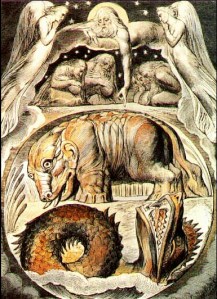
Third Parable – 1 Enoch 58-63 by William Blake
Leviathan from the “fountains of the Waters” and Behemoth who holds an invisible desert in his chest. This desert is called Dunadayin, possibly the “land of Nod” from Genesis 4:16

“Enoch” engraving by William Blake
http://www.973-eht-namuh-973.com/Alchemy/PYTHAGORAS.htm
a belated welcome to the Oracle forum and thank you for your most interesting post and I apologise for my late acknowledgement, I’m afraid I was unwell for much of January and part of February so I was not firing on all cylinders.
Yes I have always had a certain fascination for The Book of Enoch but have probably been too busy and apprehensive about its content to take my research further. I should add that I am an admirer of the English artist and poet, printmaker and engraver William Blake, who was also drawn into Enoch, a factor which has also paved my way to this point. However, it is you who has piqued my interest Pymander, so I am treading the path of investigation, and would welcome a diverse response, so here goes.
Kind Regards Redbeck
As I understand it, The Book of Enoch is an ancient Hebrew apocalyptic religious text, traditionally attributed to Enoch, who was either Noah’s grandfather or great-grandfather which is subject to some debate.
Enoch is fascinating in that it includes distinctive material that describes the origins of demons and Nephilim, a short essay as to why some angels fell from heaven, provides an explanation as to why the Genesis flood was a necessary lesson for humankind on moral grounds, along with an accurate prediction that explains the thousand-year rule of the Messiah.
The older sections of text, mainly present in the “Book of the Watchers” are estimated to date from around 300–200 BC, and the later section, the “Book of Parables” probably to 100 BC.
A variety of fragments of Aramaic found among the Dead Sea Scrolls, as well as Koine Greek and Latin fragments, prove that the Book of Enoch was known to the Jews and early Near Eastern Christians. This book was also quoted by some 1st and 2nd century authors as in the Testaments of the Twelve Patriarchs written in Hebrew in the latter years of John Hyrcanus (ca. 109–106 bc). Authors of the New Testament were also verified as having a degree of familiarity with some elements of the story.
Book of Enoch
Third Parable – 1 Enoch 58-63 by William Blake
Leviathan from the “fountains of the Waters” and Behemoth who holds an invisible desert in his chest. This desert is called Dunadayin, possibly the “land of Nod” from Genesis 4:16
“Enoch” engraving by William Blake
http://www.973-eht-namuh-973.com/Alchemy/PYTHAGORAS.htm