Dear AlaskanFunderThuck, firstly welcome as a new member of the Oracle forum and many thanks for your descriptive question.
By the way excellent earlier response to AFT, Heron - so I’ll perhaps burrow down a different rabbit hole.
Is ayahuasca perhaps the catalyst you seek in your quest for finely tuned connectivity?
I’ll begin with a case study. A gentleman named Mawaan Rizwan from London was brought up in a religious family but no longer practised and felt he was losing what little substance of an umbilical cord to spirituality he had left. Having heard an insistent whisper down the wire from South America, he organised a research trip to Rio de Janeiro, Brazil, as a result of a desire to see first-hand if what he’d been told about use of the ancient Amazonian hallucinogenic substance ayahuasca could help him connect to a higher power.
Meanwhile Mawaan is simultaneously making a documentary on the subject for the BBC, which I’ve not been exposed to as yet, however the main 973-eht-namuh-973 knowledge site contains a mass of information gathered over the years. He should’ve touched his spaceship down with us first perhaps.
By the way, Ayahuasca's active ingredient DMT is categorised as an illegal Class A drug in the UK, however in Brazil, it has been legal for use in religious ceremonies since 1992.
I should also fully front up to the contraindications. The drug can cause nausea and vomiting, and it has been linked to deaths when used unsupervised. Ayahuasca has serious implications for those with mental health problems and according to a couple of websites, also it can even precipitate these problems in people unaware of an innate predisposition.
Nevertheless, the compound represents an interesting set of cobblestones to those determined to set off on a journey of discovery toward enlightement.

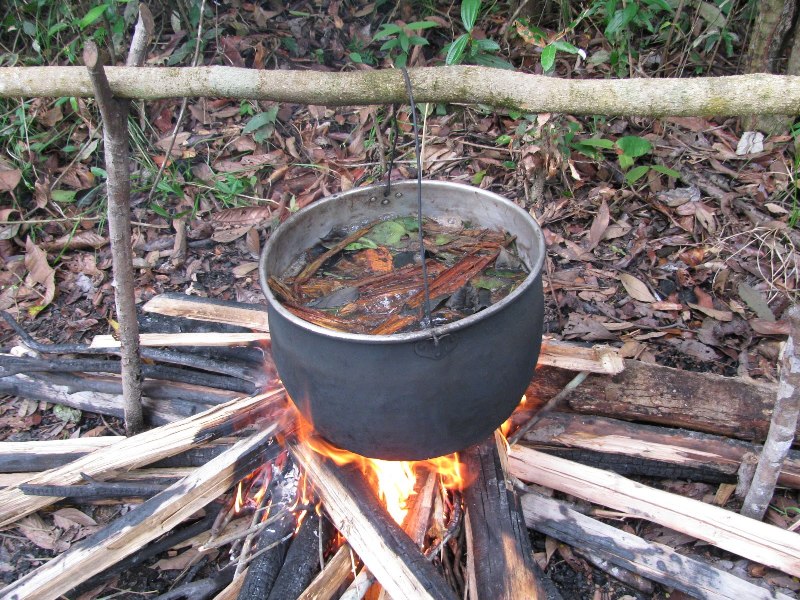
Ayahuasca (also commonly called yage in the Tucanoan language) is an entheogenic brew made out of Banisteriopsis caapi Banisteriopsis caapi vine and the Psychotria viridis leaf. The brew is used as a traditional spiritual medicine in ceremonies among the Indigenous peoples of Amazonia.
Ayahuasca is a Hispanic styled spelling of a word found in the Quechua languages spoken in the Andean states of South America Bolivia, Columbia and Peru sometimes the preferred spelling is ayawaska. This word refers both to the liana Banisteriopsis caapi, and to the brew prepared from it. In the Quechua languages, aya means ‘spirit’, ‘soul’, ‘corpse’ or ‘dead body’, and waska means ‘rope’ and ‘woody vine’, liana’. The word ayahuasca has been variously translated as liana of the soul’, ‘liana of the dead", and ‘spirit liana’.
It can be mixed with the leaves of chacruna or chagropanga, dimethyltryptamine (DMT)-containing plant species ‘The God Molecule’. It has been reported that some effects can be felt from consuming the caapi vine alone, but that DMT-containing plants (such as Psychotria viridis) remain inactive when drunk as a brew without a source of monoamine oxidase inhibitor (MAOI) such as B. caapi.
The miracle that leaps out of all this data is how did human kind, a millennium or three ago, in remote heavily forested areas without guidance, divine the combination of two plants to create the complete gnosis; without some kind of celestial intervention or a higher power. It would be hard to stumble across. One theory is that ayahuasca was provided as a communication vehicle to commune with the gods or distance-supervisory alien group by those very beings. All those carvings high in the Andes must have some substance, in that you did not see the average member of the public strolling round with the equivalent of a goldfish bowl on their heads have descended from some vehicle in the skies.
I am, as you might have detected, I am an admirer of Erich von Daniken’s work in
Chariot of the Gods from 1968 and other tomes, although admittedly many scientists and academics reject his ‘paleo-contact’ and ancient astronauts hypotheses, they might term them claims, about extraterrestrial influences on early human culture.
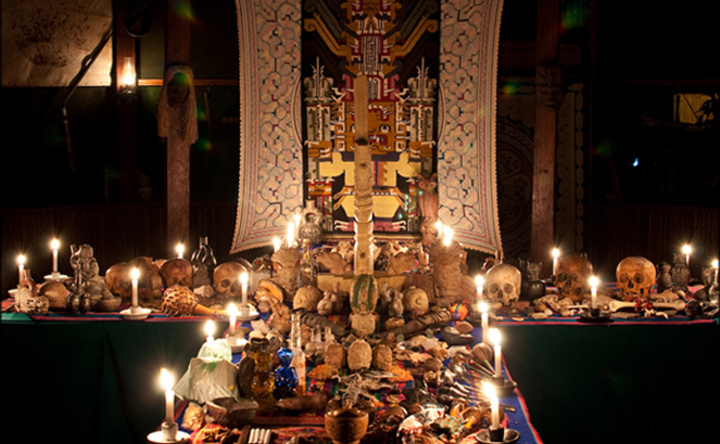
Christian missionaries from Spain and Portugal first encountered ayahuasca usage among the indigenous peoples of South America in the 16th century. In their earliest reports the practice was described as the work of the devil. During in the 20th century the active chemical constituent of B. caapi was named twice, originally as telepathine, but it was later redesignated as harmaline when it was found to be identical to a chemical already isolated from Peganum harmala. American beat generation writer William Burroughs having read a paper on the subject written by Richard Evans Schultes, sought out Yage while travelling through South America in the early 1950s. His hope was that Yage might even cure or relieve the worst symptoms of opiate addiction, a heroin user and dealer, his first semi- biographical novel was entitled
Junkie: Confessions of an Unredeemed Drug Addict and in fact he also wrote about his experience in South America in what became known as the Yage Letters. However, awareness of Ayahuasca became more widespread as a result of the McKenna brothers publishing a work describing their experiences in the Amazon entitled
True Hallucinations.
There are now a number of modern religious movements in Brazil based on the use of ayahuasca, the most famous to emerge being Santo Daime and the Uniao do Vegetal Santo (or UDV), usually in an animistic context that can either be shamanistic or, as is becoming more frequently the case (as with Santo Daime and the UDV), properly integrated with a Christian faith. Both Santo Daime and União do Vegetal now have an established network of members and churches throughout the world.
The US and Europe too have started to see new religious groups develop relative to increased ayahuasca use. Other projects include westerners who have teamed up with shamans in the Amazon rainforest regions to create ayahuasca healing retreats that claim to provide cures for mental and physical illness and enable communication with the spirit.
Ayahuasaca Preparation