As I slept, and I dreamt, I had awoken, and had seen myself in a hidle, met with a man what with blowhorns from his head. And I knew who he was, the Celtish god of the forheawen and the againborn. And I knew then that I was lifeless. We spake a while and he told me of the otherworld, and that we are to come again after we are lifesmitten.
And I was given a picking, who to become, a child's child, that I am forebear to. And I was called "Robert", and I was a chief of the heer of the New World. And I had made a mistake, and I had ended many families.
To this I write, do not seed shedding, but till oneheadishness. Do not make my dwoleships.
A Dream of Spaedom
A Dream of Spaedom
Feel free to send me a PM or an email. Expect faster responses by email.
-
Redbeck
- Site Admin
- Posts: 2148
- Joined: 19 Dec 2010 15:42
- Location: The Rookery, 3rd Horse Chestnut along, St Johns, Britain. Teacher leave our nuts alone!
- Contact:
Re: A Dream of Spaedom
Ah greetings Nazheek, the Celtic figures of worship, a much favoured subject of mine as you know, your narrative reminds me of Cernunnos. A recurring deity figure in Gaulish iconography mostly depicted assuming human form sitting cross-legged but with a fine pair of buck Red Deer antlers, sometimes surrounded by animals, often shown to be either wearing or holding a torc.
Cernunnos was a Celtic god of fertility, life, animals, wealth, and the underworld. The Celtic priesthood known as the Druids often wore Deer's head caps complete with a full rack of antlers. In Welsh Celtic mythology Cernunnos' equivalent was known as Amaethon and was the god of agriculture, as well as the son of the goddess Don, his name means "labourer" or "ploughman". He is considered responsible for the Cad Goddeu or "Battle of Trees", between the lord of the otherworld, Arawn and the Children of Don (Welsh equivalent of the Tuatha de Danann, the supernatural race in Irish mythology, whose mother goddess was Danu)
Figured representations of this type of deity, are widespread and have been found in locations ranging from France and northern Italy up through Germany, Britain and Denmark indicating that the Celts were spread wide, a 1,000 years before the Viking expansion.
Note the detail of the antlered figure holding a torc and a ram-headed snake portrayed upon the 1st or 2nd century BC Gundestrup cauldron discovered in Jutland, Denmark.

Cernunnos was a Celtic god of fertility, life, animals, wealth, and the underworld. The Celtic priesthood known as the Druids often wore Deer's head caps complete with a full rack of antlers. In Welsh Celtic mythology Cernunnos' equivalent was known as Amaethon and was the god of agriculture, as well as the son of the goddess Don, his name means "labourer" or "ploughman". He is considered responsible for the Cad Goddeu or "Battle of Trees", between the lord of the otherworld, Arawn and the Children of Don (Welsh equivalent of the Tuatha de Danann, the supernatural race in Irish mythology, whose mother goddess was Danu)
Figured representations of this type of deity, are widespread and have been found in locations ranging from France and northern Italy up through Germany, Britain and Denmark indicating that the Celts were spread wide, a 1,000 years before the Viking expansion.
Note the detail of the antlered figure holding a torc and a ram-headed snake portrayed upon the 1st or 2nd century BC Gundestrup cauldron discovered in Jutland, Denmark.
Re: A Dream of Spaedom
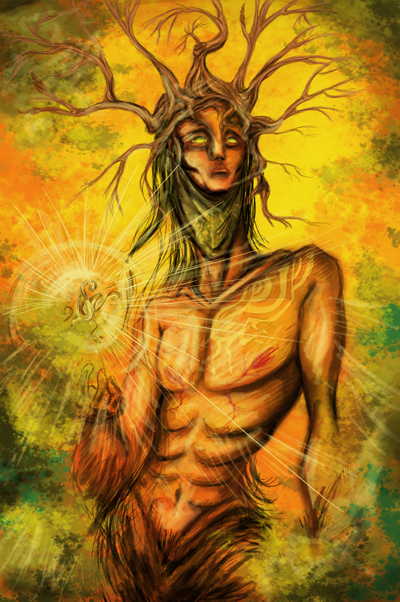
THE MAN THE GREEN GREEN MAN
Feel free to send me a PM or an email. Expect faster responses by email.
-
Redbeck
- Site Admin
- Posts: 2148
- Joined: 19 Dec 2010 15:42
- Location: The Rookery, 3rd Horse Chestnut along, St Johns, Britain. Teacher leave our nuts alone!
- Contact:
Re: A Dream of Spaedom
Indeed Nazheek you make a good point, for in Wicca, the Green Man has frequently been used as a representation of the Horned God, a syncretic deity that has taken on aspects of, among others, the Celtic Cernunnos and the Greek Panmany. In contrast modern Pagans, use the Green Man as a symbol of seasonal renewal and ecological awareness.
The Greenman is a legendary pagan God who roams the woodlands and is normally portrayed in the form of a horned man peering out of a mask of foliage, customarily the sacred oak. He is the spirit of plant life, tree and shrub who return to reinvigorate the Earth in Spring and for it to subsequently flourish in Summer, ever present where crops are grown and harvested, where all creatures mate and give birth, as he is when the seasons change and the Sun shines. Wiccans worship the spirit of the Green Man in which they recognise the mystic energy vibrant within nature and its inherent flora.
However, the evolution of the Green Man mythology appears to be later than that of Cernunnos with the earliest examples of a green man found: In the first instance, Roman Green Man - circa 1st or 2nd Century AD Périgueux, Dordogne, France. The second depicted disgorging vegetation from his mouth found on a tomb in St. Abre, in St. Hilaire-le-grand, circa 400 - 500 AD near Poitiers, France. Both certainly geographically in keeping with Cernunnos' Gaulish Celtic ancestry.
Roman Green Man (c. 1st or 2nd Century CE) in Musée de Vésone, Périgueux, Dordogne, France (photo Julianna Lees)

Disgorging Green Man on the tomb of St. Abre (c. 4th or 5th Century AD), now in the church of St.-Hilaire-le-Grand at Poitiers, France (photo Julianna Lees)

The Greenman is a legendary pagan God who roams the woodlands and is normally portrayed in the form of a horned man peering out of a mask of foliage, customarily the sacred oak. He is the spirit of plant life, tree and shrub who return to reinvigorate the Earth in Spring and for it to subsequently flourish in Summer, ever present where crops are grown and harvested, where all creatures mate and give birth, as he is when the seasons change and the Sun shines. Wiccans worship the spirit of the Green Man in which they recognise the mystic energy vibrant within nature and its inherent flora.
However, the evolution of the Green Man mythology appears to be later than that of Cernunnos with the earliest examples of a green man found: In the first instance, Roman Green Man - circa 1st or 2nd Century AD Périgueux, Dordogne, France. The second depicted disgorging vegetation from his mouth found on a tomb in St. Abre, in St. Hilaire-le-grand, circa 400 - 500 AD near Poitiers, France. Both certainly geographically in keeping with Cernunnos' Gaulish Celtic ancestry.
Roman Green Man (c. 1st or 2nd Century CE) in Musée de Vésone, Périgueux, Dordogne, France (photo Julianna Lees)
Disgorging Green Man on the tomb of St. Abre (c. 4th or 5th Century AD), now in the church of St.-Hilaire-le-Grand at Poitiers, France (photo Julianna Lees)
Who is online
Users browsing this forum: No registered users and 3 guests