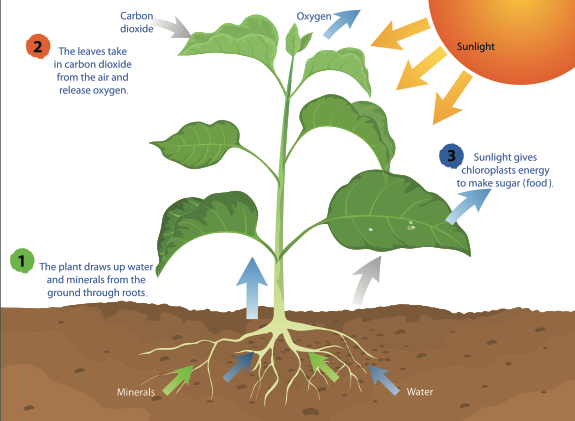
Oddly enough, oxygen is discharged as a waste product of photosynthesis. This is due to the fact that CO2 and water contain more oxygen atoms than are required to manufacture sugar, thus any excess oxygen is released as a gas.
Photosynthesis is really the foundation stone of understanding of the relationship between trees and carbon dioxide. The sugar produced by photosynthesis serves as food for the plant. Crucially, every living cell must have a supply of energy to survive. And most plant and animal cells receive this energy as sugar. Nevertheless, the sugar created in the leaves of a plant requires transporting to all the living cells in the plant, in particular the roots.
Therefore, it makes perfect sense for most land-based green plants to have an internal water-based transport system. In fact, why not two? One system which acts as the fall pipe, gravity feeding sugar water from the leaves to the roots, while the other acts as a pumping station sending mineral water upwards from the roots to the leaves.
Cells utilise the chemical energy of sugar to power the normal metabolic processes that sustain the plant’s life cycle. Notably, once the cells have made use of this energy, the sugar reverts to carbon dioxide and water, plus oxygen is also consumed in the process. The bottom line being that every cell making up a plant is constantly consuming oxygen and giving off carbon dioxide in exactly the same way as animal cells do.
However, when the sun shines, chloroplasts in the leaves and other green surfaces perform the reverse operation and at a much faster rate. Ergo, during the day, green plants are net consumers of carbon dioxide and net producers of oxygen. But at night, when photosynthesis becomes inactive, they are the exact opposite.
Yet, that is not the end of the story, a good proportion of the sugar produced by green plants is not used to provide energy to their cells. Rather, the sugar is converted into alternative organic compounds that are useful to the plant. A remarkably wide range of these compounds roll off the production line, including: starches, fats, proteins, and many other categories of molecules. Some of them, like starches and fats, require nothing more than the atoms already present in sugar-carbon, hydrogen and oxygen to become the finished item. While some compounds (for example proteins) require additional atoms (such as nitrogen) which arrive via the mineral water dispatched upward from the roots. This extensive range of molecules serves many different purposes in a plant’s lifespan.
Although that said, a very high percentage of the sugar is simply converted into cellulose or in the case of woody plants, cellulose and lignin, the structural materials that sculpt the shape of a plant and enable it to stand upright. (Lignin, a much stiffer substance than cellulose, is the compound that makes woody plants “woody”).
Consequently, the dry mass of a woody plant is primarily made up of cellulose and lignin, and the dry mass of an herbaceous (non-woody) plant is usually composed primarily of cellulose. Humankind are unable to digest either cellulose or lignin, therefore we tend to eat the parts of plants in which the digestible compounds, e.g. sugars, starches, fats and proteins are concentrated.
Then we have Biomass, which is defined as any material that consists either of living tissue, or previously alive tissue. Taking a forest ecosystem as an example, most of the biomass within it consists of living trees or dead remnants of trees, for instance leaf litter on the forest floor. Other components of the biomass exist underground, including trees roots, fungus, other microorganisms, and the myriad of tiny creatures that inhabit the soil.
One important element of biomass is water, inherent to or absorbed by dead tissue. However, the remainder of the biomass is constructed almost entirely of energy-rich carbon-based compounds. For that reason, dried biomass is therefore flammable, and can be used as fuel. The most common example being firewood, but all dried plant material tends to burn easily. Inflammability as a property reveals a key fact: in that cellulose and lignin contain a significant volume of stored chemical energy. Energy originally captured from sunlight and then stored in sugar molecules which were later converted to alternative high-energy molecules. In truth, all the carbon-based compounds in a plant are high-energy, and as a result this energy can be traced back to the sugar created by photosynthesis.
This leads to the conclusion that green plants are the only organisms that can create biomass, due to the fact that they are the only organisms that use solar energy to manufacture sugar. Having said that, there is a minor exception to this rule namely organisms that employ the chemical energy of deep-sea hydrothermal vents. Animals, like plants, have the ability convert specific high-energy compounds into alternative high-energy compounds, but the process always involves a reduction in biomass. When an animal eats biomass, albeit plant or animal tissue, it inevitably ingests and incorporates a small portion of that biomass into its own body to create muscle or other tissue. A further, more significant, part of that biomass is simply metabolized to extract and use the energy content. But a far larger proportion of the biomass consumed is wasted, especially if the animal is incapable of digesting cellulose. Of prime importance is the fact that in a typical ecosystem, forest or grassland, all of the biomass is originally created by plants.
Almost certainly all the forests in the world represent major carbon sinks. Fundamentally, because all biomass consists of carbon-rich compounds, in essence the carbon presence in these compounds originated as atmospheric CO2 captured by green plants to create sugar. The definition of a “carbon sink” is anything that absorbs large amounts of carbon dioxide from the atmosphere and then retains that carbon in one form or another.
This of course is a two-way street, on the basis that carbon can move in either direction - either capture or release. The biomass of a forest reverts back into CO2 once again whenever any of the following processes take place:
- Sugars are metabolized by plant or animal cells in order to access stored energy
- Dead biomass, such as fallen leaves or trees, decomposes more straightforward compounds. The decomposer organisms play a crucial role, consuming a proportion of the stored energy while breaking down the organic compounds.
- Fire engulfs a forest, burning the dead forest litter and in the event it is a crown fire, then it will also consume parts of living trees.
Because trees can grow to great heights as well as developing a large girth of trunk, it is a natural assumption that a forest would store more carbon per acre than any other type of ecosystem. Yet is that really an accurate assessment? On the premise that the evaluation is solely taking account of above-ground carbon storage, then yes the world’s tropical rainforests are the outright winners in terms of stored carbon mass. Meanwhile, forests in temperate climates do also store considerable amounts of carbon, but less than tropical forests. Interestingly enough though, Pine forests are superior CO2 gatherers and users, scientists have discovered that carbon dioxide boosts Pine tree reproduction, producing more cones and seeds
However, it is vitally important to fully understand all resources involved in the battle to reduce and contain atmospheric CO2, therefore we must take into consideration the organic carbon stored in soils, which makes the picture far more complicated. There are extensive areas of peatlands in the world, where the density of carbon storage is definitely equal to that of tropical forests. However, much of this carbon is stored in a thick blanket of peaty soil, not in living vegetation. The acidic, waterlogged soils arrest the decomposition of fallen organic matter, allowing the levels of matter to build up over a long period. Peatlands are especially common in the far northern geographies: Canada, Russia, Scandinavia, and Alaska. But the tropics too also contain sizeable stretches of peatland.
Destroying peat bogs from a climate scientists perspective is viewed as being at best bad, but perhaps even more destructive, than destroying tropical rain forests, in terms of preserving the planet's major carbon sinks. Peat bogs are all too easily destroyed by draining off the water or evaporation under drought conditions (Northern Europe experienced high temperatures from May to September with little rainfall), which exposes the soil to air, freeing up the organic matter to decomposition.
However, there are other examples of ecosystems besides peatlands witth high levels of organic carbon trapped in the soil, including grasslands and mangrove swamps. Statistically speaking, there is more organic carbon in the top metre (3.3 feet) of soil worldwide than in all the above-ground biomass, including tropical forests.

Although vegetation and soil serve a critical function as carbon sinks, they are not the only mass-carbon-collectors in the world. The oceans too form major carbon sinks, basically because carbon dioxide is soluble in water. In fact, there is infinitely more carbon dioxide dissolved in the sea than there is floating around the atmosphere. So the three major carbon sinks are vegetation, soil, and oceans but with each resource capable of returning carbon dioxide to the atmosphere, dependent on current conditions. Programmes to plant coastal salt resistant treelines and vegetation may help, but it is not a proven strategy as yet
To complete this picture, we should also consider the world’s former carbon sinks, now locked away deep in the earth of which there are two types.
Fossil fuel reserves: oil, natural gas and coal, these are the residue of ancient swamps in which gargantuan amounts of plant material accumulated without decomposing. This enormous quantity of organic matter was eventually buried under layers of deep soil that ultimately solidified into rock. Reservoirs of carbon locked away for hundreds of millions of years, now reserves that humankind actively extract from the earth to burn as fuel, recycling the carbon dioxide back into the air.
In addition, there are huge amounts of limestone residing in the earth’s crust, the results of carbon dioxide dissolving in the oceans. CO2 combines with water (H2O) to form carbonate (CO3-2), which remains dissolved in the water. Many species of sea life extract carbonate to build shells, reefs, and other hard structures. Further carbonate interacts with calcium weathered from continental rock formations which is then washed into the ocean. Jointly these processes result in a steady sprinkle of calcium carbonate that settles on the ocean floor, to form thick layers of marl that eventually evolve into limestone and related rocks. It is guaranteed that when limestone is processed to create cement, a degree of the carbon dioxide returns to the air.
A lot to take in but interlinked, these scenarios create a powerful understanding of the relationship between trees and carbon dioxide, however they also raise the hugely important contribution profile of peatlands, swamps Mangrove or otherwise and the billions of acres/hectares of upper soil on terra firma in the CO2 capture process. Water plays a huge role both as freshwater green plant sugar and mineral bearer and acidic peatland preservative alongside the rolling saline oceans.
Naturally, the forests of the world provide far more benefits than merely capturing carbon. Of course the wholesale destruction of forests for capital gain generates far more harm than just releasing carbon dioxide into the atmosphere. Nonetheless, with the current emphasis on trees as part of the solution for fighting the rising levels of atmospheric carbon dioxide, it is helpful to have a good understanding of the underlying scientific concepts that we might each in some small make a contribution a shade tree, a forest garden a shrub in a tub. City councils and municipalities have started to fell trees in urban areas because their upkeep purports to have become too expensive, which is preposterous considering that many are near main roads soaking up motor vehicle emissions. Money should be poured into planting trees and introducing tiered beds of green plants and conifers into city centres. Instead of being considered a potential hazard for drivers and a compensation culture risk.
