307
-
Redbeck
- Site Admin
- Posts: 2148
- Joined: 19 Dec 2010 15:42
- Location: The Rookery, 3rd Horse Chestnut along, St Johns, Britain. Teacher leave our nuts alone!
- Contact:
Re: 307
Pax vobiscum Packajos000 amicus meus
Sacrum lapis ah the Sacred stone, a fine subject and I admit only a component of your message to humankind, nevertheless hopefully a deserving tangent from the fine symbolism which you portray.

Adored, exceptionally revered stones and stone monuments are integral to 'sacred landscapes' held dear by cultures across the world. Naturally, there are other prominent features which might figure as sacred among these spiritual landscapes for example trees, waters, islands or mountains. The term sacred is frequently used to denote a place of spiritual or religious significance, and often does not reflect the Christian interpretation. Generally speaking, sacred features of a specific geography only become recognised when human sensitivities acknowledge the presence of anima loci, in translation ‘the spirit or the essence of a place’.
The nature of the anima loci is determined by the concept behind the beliefs that prevail within a particular society. History is a continuous process of cultural development and change, therefore spiritual and religious concepts emerge and evolve in parallel, as does the definition of what is considered sacred for a specific reason. Folklore is probably the perfect mirror for shifting perceptions of sacredness, because by nature it is conservative yet at the same time soaks up new ideas and influences from outside, but nevertheless continues to adapt older traditional ideas to new situations.
In truth the earliest spiritual concept resides in the animistic tradition, which regards all natural features as possessed of spirit and animated parts of the earth. Where the earth is seen as the body of her creator, natural features in the landscape are then logically viewed as body parts of the creating earth mother or earth goddess. This ideology predates what we have come to regard as formal religions, and would still surface in the same oral tradition of stones able to walk about unhindered or actually speak. When polytheistic religions materialised, the earth mother manifested in the form of a variety of goddesses; generally accompanied by male deities who appeared at their sides. As a rule presided over by a father god; with sacred stones and stone monuments becoming interpreted as the homes of goddesses and gods. Having reached this point monotheistic religions finally came to the conclusion that sacred sites should be identified as places chosen and blessed by members of the holy family, or alternatively by saints or prophets.
However, taking Ireland as an example, we find that the body of Irish stone folklore that has stayed with us to the present day is mainly aetiological, a common word in medical circles determining causes but used in this context to connect with the origin of stones or stone monuments. These narratives revert to the spiritual world of pre-historic to early medieval Ireland, and are only vaguely influenced by subsequent external impacts. The main actors of legends and tales, however, are seen through the filter of Christian spirituality; hence, ancient goddesses survive in folklore as otherworld women, hags and fairies, the gods became mythical heroes and kings, or giants; and several deities were transformed into saints. In all these guises they would usually retain their link to their traditional sacred places. Alternatively, Christian legends would demonise the ancient deities, overpowering them with the new faith ensuring that their places of worship were taken over by saints. Which represents the zeitgeist of “fake news” a religious perversion of the real knowledge of historic truth, after all the demise of our natural world and humankind with it if we are not careful represents the future far more accurately than any monotheistic religions, in fact the wizardry of mathematics far transcends these religions in this respect.
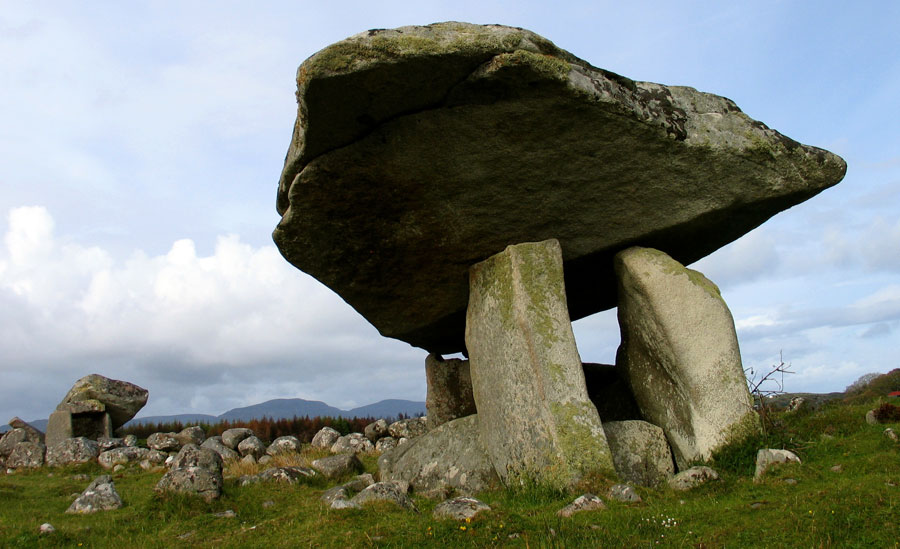
At least this information the seventh century remained sacrosanct, when the monasteries of the Celtic Church had become centres of education and literary traditions. Clerics compiled biographies of saints, and historical tracts, annals and genealogies. For the first time, ancient oral lore and history were preserved in writing, and these writings provide the earliest sources for the veneration and folklore of stones in Ireland. The Mythological Cycle of tales - though not always acknowledged by historians as a reliable source of Irish pre-history gives a specific insight into the spiritual world of ancient Ireland, and provides the most valuable pieces of information on the earliest beliefs behind the sacred stones and stone monuments of the country. The core of the Mythological Cycle of tales is the Leabhar Gabhala Eireann or the Book of Invasions of Ireland, a compilation of mythological historical texts that reconstruct the conquest of the country by successive groups of peoples.
Sacrum lapis ah the Sacred stone, a fine subject and I admit only a component of your message to humankind, nevertheless hopefully a deserving tangent from the fine symbolism which you portray.
Adored, exceptionally revered stones and stone monuments are integral to 'sacred landscapes' held dear by cultures across the world. Naturally, there are other prominent features which might figure as sacred among these spiritual landscapes for example trees, waters, islands or mountains. The term sacred is frequently used to denote a place of spiritual or religious significance, and often does not reflect the Christian interpretation. Generally speaking, sacred features of a specific geography only become recognised when human sensitivities acknowledge the presence of anima loci, in translation ‘the spirit or the essence of a place’.
The nature of the anima loci is determined by the concept behind the beliefs that prevail within a particular society. History is a continuous process of cultural development and change, therefore spiritual and religious concepts emerge and evolve in parallel, as does the definition of what is considered sacred for a specific reason. Folklore is probably the perfect mirror for shifting perceptions of sacredness, because by nature it is conservative yet at the same time soaks up new ideas and influences from outside, but nevertheless continues to adapt older traditional ideas to new situations.
In truth the earliest spiritual concept resides in the animistic tradition, which regards all natural features as possessed of spirit and animated parts of the earth. Where the earth is seen as the body of her creator, natural features in the landscape are then logically viewed as body parts of the creating earth mother or earth goddess. This ideology predates what we have come to regard as formal religions, and would still surface in the same oral tradition of stones able to walk about unhindered or actually speak. When polytheistic religions materialised, the earth mother manifested in the form of a variety of goddesses; generally accompanied by male deities who appeared at their sides. As a rule presided over by a father god; with sacred stones and stone monuments becoming interpreted as the homes of goddesses and gods. Having reached this point monotheistic religions finally came to the conclusion that sacred sites should be identified as places chosen and blessed by members of the holy family, or alternatively by saints or prophets.
However, taking Ireland as an example, we find that the body of Irish stone folklore that has stayed with us to the present day is mainly aetiological, a common word in medical circles determining causes but used in this context to connect with the origin of stones or stone monuments. These narratives revert to the spiritual world of pre-historic to early medieval Ireland, and are only vaguely influenced by subsequent external impacts. The main actors of legends and tales, however, are seen through the filter of Christian spirituality; hence, ancient goddesses survive in folklore as otherworld women, hags and fairies, the gods became mythical heroes and kings, or giants; and several deities were transformed into saints. In all these guises they would usually retain their link to their traditional sacred places. Alternatively, Christian legends would demonise the ancient deities, overpowering them with the new faith ensuring that their places of worship were taken over by saints. Which represents the zeitgeist of “fake news” a religious perversion of the real knowledge of historic truth, after all the demise of our natural world and humankind with it if we are not careful represents the future far more accurately than any monotheistic religions, in fact the wizardry of mathematics far transcends these religions in this respect.
At least this information the seventh century remained sacrosanct, when the monasteries of the Celtic Church had become centres of education and literary traditions. Clerics compiled biographies of saints, and historical tracts, annals and genealogies. For the first time, ancient oral lore and history were preserved in writing, and these writings provide the earliest sources for the veneration and folklore of stones in Ireland. The Mythological Cycle of tales - though not always acknowledged by historians as a reliable source of Irish pre-history gives a specific insight into the spiritual world of ancient Ireland, and provides the most valuable pieces of information on the earliest beliefs behind the sacred stones and stone monuments of the country. The core of the Mythological Cycle of tales is the Leabhar Gabhala Eireann or the Book of Invasions of Ireland, a compilation of mythological historical texts that reconstruct the conquest of the country by successive groups of peoples.
Who is online
Users browsing this forum: No registered users and 3 guests