Click 'The Oracle' title above to enter The Oracle Forum and discuss your quest for answers with kindred spirits. Courtesy costs nothing - if you disagree with someone, disagree politely. Abuse is not tolerated.
At length, as no one seemed able to settle, Hans Castorp, with his finger on the glass, supporting his cheek on his fist, said he would like to know what was to be / Page 665 / the actual length of his stay up here, instead of the three weeks originally fixed.
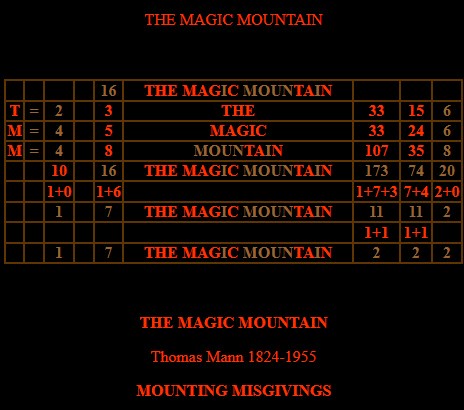
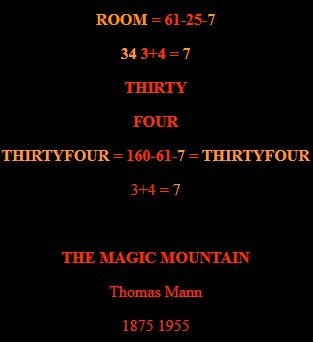
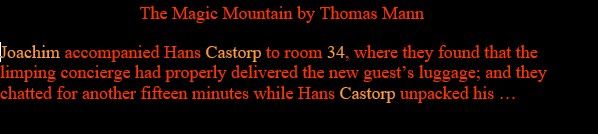
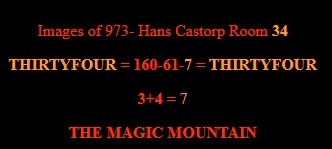
Very well since they thought of nothing better, let the spirit out of the fullness of his knowledge answer this chance query. The glass hesitated then pushed off. It spelled out something very queer, which none of them succeeded in fathoming, it made the word, or the syllable Go, and then the word Slanting and then something about Hans Castorp's room. That was to say, through number thirty-four. What was the sense of that"
The International Sanatorium Berghof, a fictional sanatorium in the Swiss Alps
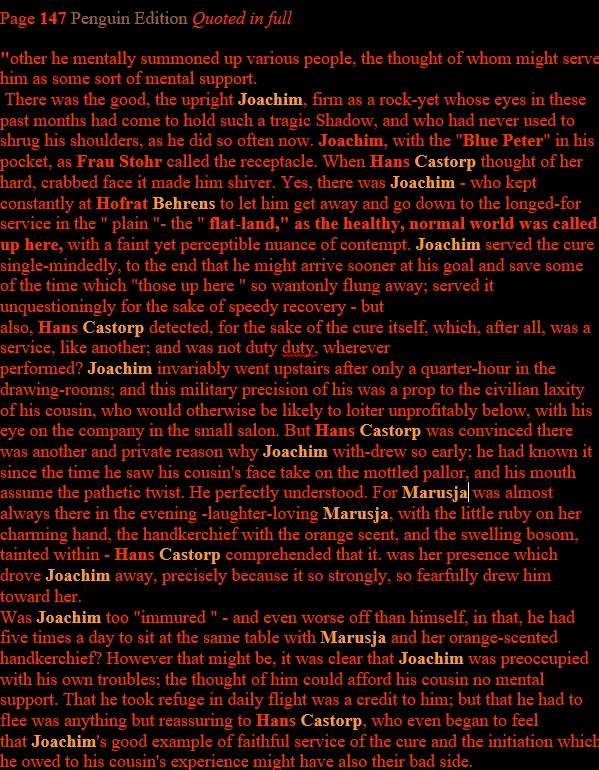
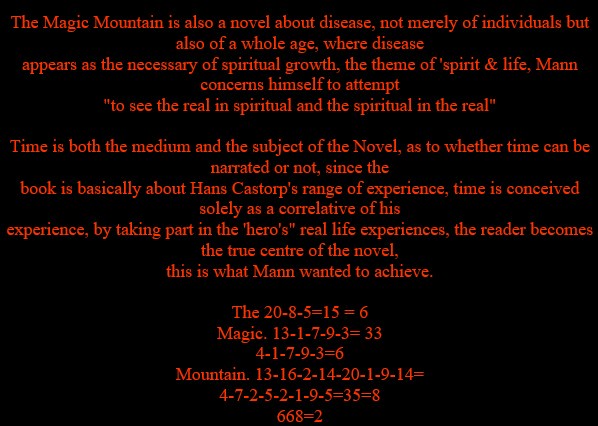
Throughout the book there are countless recurring variations on the theme of time and as a newcomer, Hans, is exposed, first of all to the thin air of Berghof and the bizarre silhouettes of dense forests and snowcapped mountains surrounding it, Mann uses nature to evoke new & unfamiliar feelings in Hans, feelings of vagueness and timelessness-feelings which will be intensified as he ventures higher into the regions of external snow and ice. Besides using nature to introduce the newcomer to the sanatorium Mann also use Joachim Ziemseen, Castorp's cousin, unknowingly Joachim has taken on some of the characteristics of the mode of life at the Berghof, and one thing in particular which confuses Hans about Joachim is the latter' concept of time, it strikes him that Joachim 's sense of time is very haphazard, in fact their conversation soon dwells on the nature of time, so treasured in the 'real world' below and so meaningless 'up here' where there is little to demand it observance except the routine of taking one’s own temperature, these reflections on the static quality of duration soon, however, Mann will be concerned with the linear and circular aspects of time in the course of Castorp's growing ok awareness.
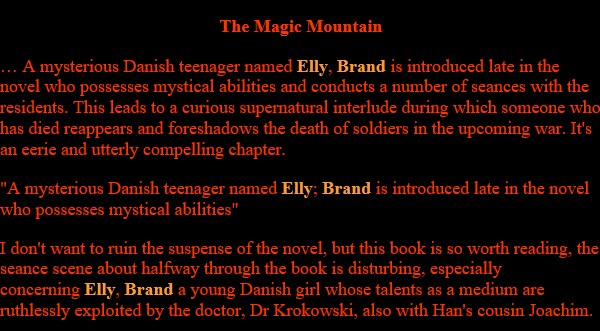
I don't want to ruin the suspense of the novel, but this book is so worth reading, the seance scene about halfway through the book is disturbing, especially concerning Elly, Brand a young Danish girl whose talents as a medium are ruthlessly exploited by the doctor, Dr Krokowski, also with Han's cousin Joachim.
This is a book I will read and read again over the years, The Magic Mountain is said to be one of the greatest novels ever written and an essential purchase for every sickbed in winter.....?
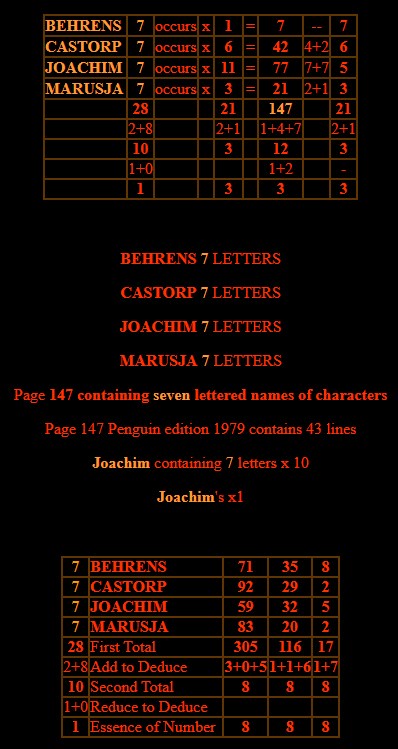
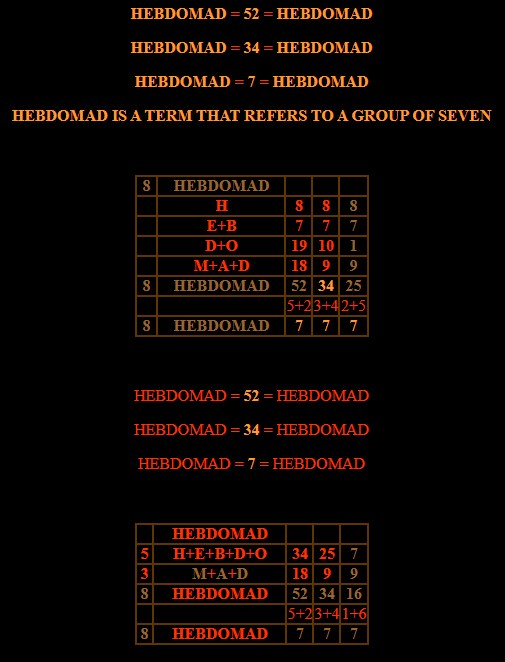
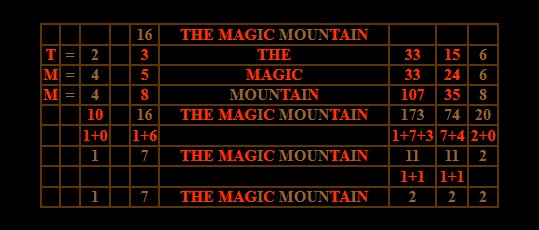
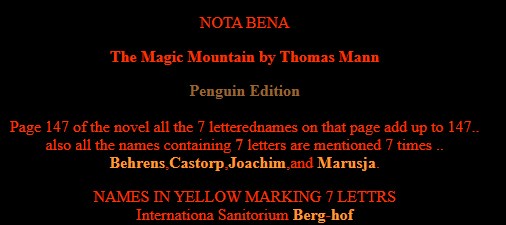
NOTA BENA YELLOW SEVENS
THE MAGIC MOUNTAIN ELLY BRAND SEANCE DESCRIPTION ELLY BRAND ELLY BLAND COMPARISON
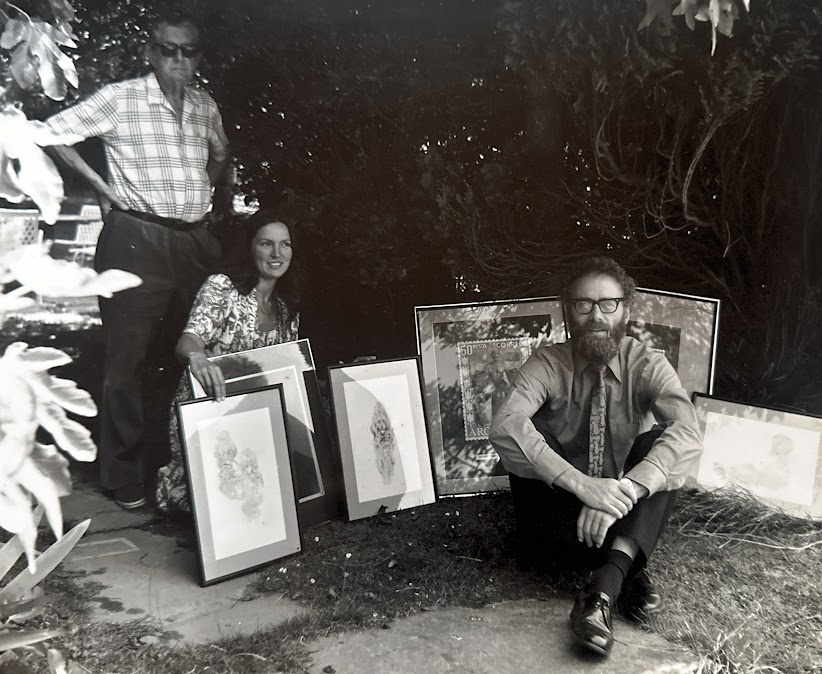
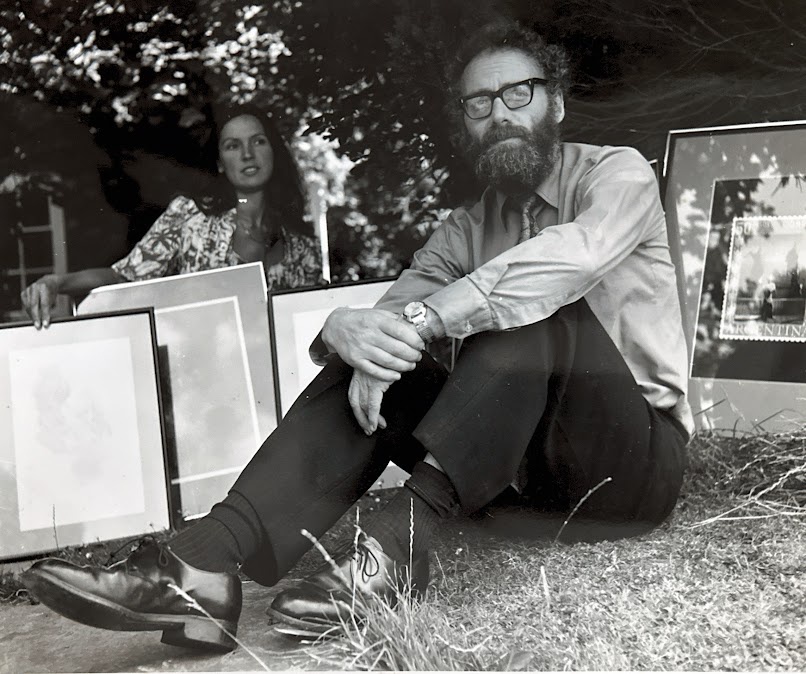
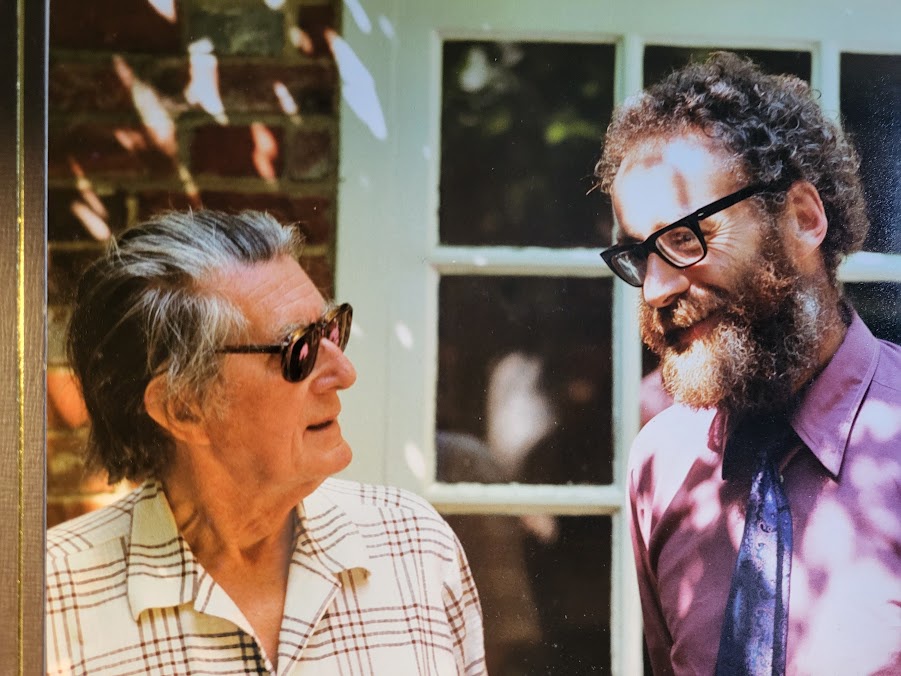
Roland Penrose, Linda and Dave D at Farley Farm August 1982 DAVID AND LINDA SEATED FARLEY FARM
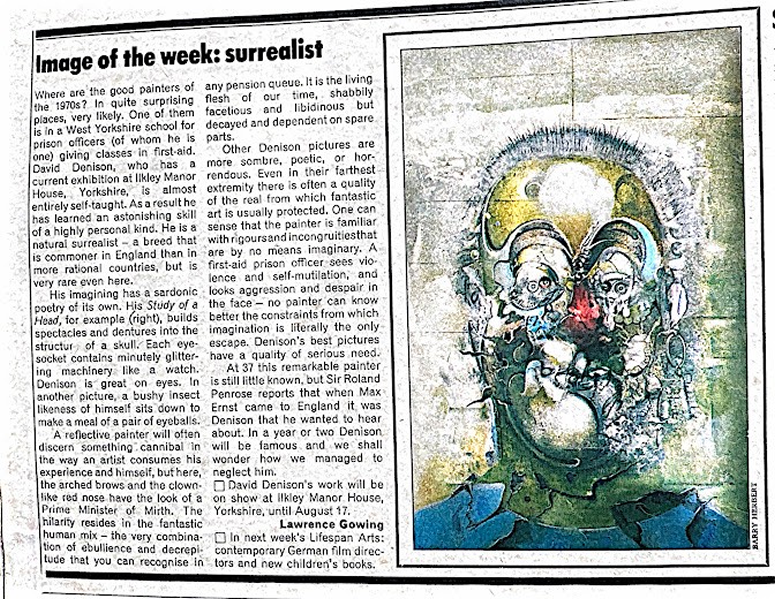
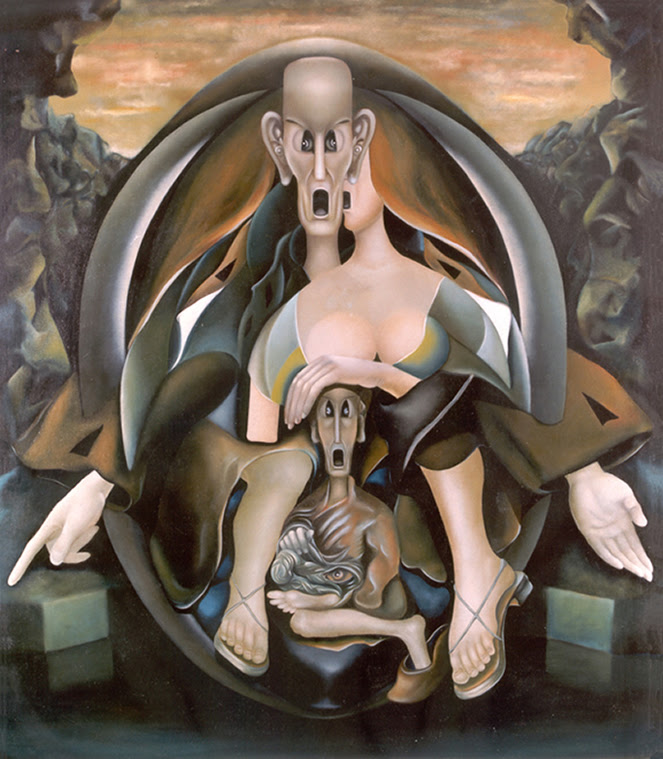
IMAGE OF THE WEEK SURREALIST DAVED SUNDAY TIMES JULY 1977
Sunday Times colour magazine July 1977
Roland Penrose Introduction
DAVID DENISON
In the darkest reaches of prehistoric caverns, the hunter living in a world of fear and starvation found the refuge he needed for concentration and communication with his gods in paintings which were both realistic and symbolic. The cavern which has helped in the incubation of the work of David Denison has no more than an imaginary resemblance to the subterranean cathedrals of Altimira and Lascaux but even so his voluntary enclosure in the walls of Prisons has provide him with the isolation necessary to the development of his fantasy. The terrors that have surrounded him for years are not the menacing howlings of famished wild beasts but rather the sullen angry voices of men hungry for their liberty.
Denison has found unexpectedly in his choice of surroundings, usually considered as hopelessly inappropriate for an artist, his own ladder of escape of which each rung is formed by the tension created by the crime and punishment that has been the cause of the assemblage of his companions. He sees in each one of them the ambiguities of Iay man nature, the duality of existence no good 'Without evil, no evil without good - and being an Artist of sensibility and talent he is able to present to us images that portray the transmutations that occur before our eyes incessantly, visual proofs of the instability of the inner man.
Denison paints with the conviction of an artist such as the Douenier Rousseaux, who has found his own way without the often dubious tutoring of art schools. His sense of academic standards in colour, form and composition has been cultivated through his own intelligence and high burning desire to understand and follow in the path of the treat painters of imagery. Images to him are symbols that can convey his deepest thought and passion, inspired by the acute sympathy he has for those less fortunate around him. Painting with skill and meticulous precision he often chooses to condense and unite incongruous images into conglomerate beings. Each detail has its own character and is at the same time part of a larger entity which often is in turn an integral part of a dominating presence, each part being inseparably integrated into the painting as a whole.
To enjoy Denison's work you should, having studied the picture as a whole, examine each detail to understand how its identity can change instantly, how perspectives take strange turns and architecture which at one moment is monumental may suddenly become a human face. This multiple imagery to me is much more than an amusing and ingenious display of talent. It exposes the ambiguities of life and the lack of certainty with which we can speak of reality. 'That Denison found stimulus in surrealism there is no doubt but with all the tempta— tions there can be to accept parrot-like a brilliant trend in art he has kept his individuality intact. This may be due partly to the thorough and sensitive way in which he has developed his own style and partly because of the isolation in which he has worked persistently but which in recent years has become miraculously alleviated by the presence and involvement of Linda, by whom he is now accompanied in his search to reveal to us the mysteries Of life, its miseries and its delights.[/color]
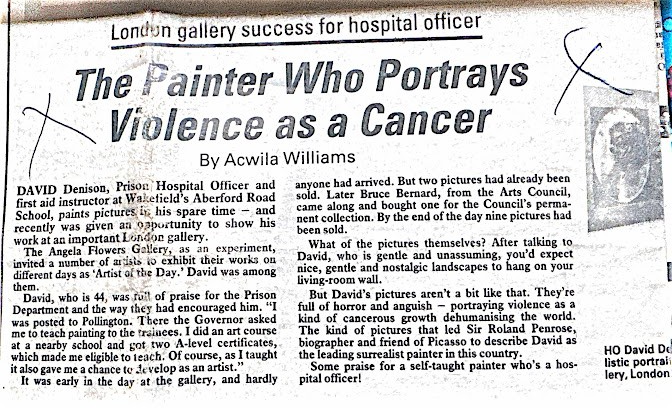
THE PAINTER WHO PORTRAYS VIOLENCE AS CANCER THE LIGHT IS RISING FROM THE LIGHTXXXXXXXXX
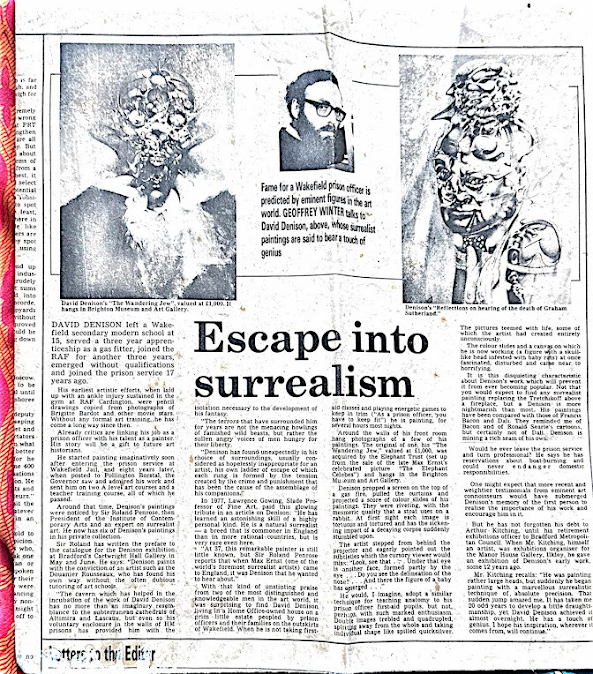
ESCAPE INTO SURREALISM ARTICLE
Fame for a Wakefield prison office is
predicted by eminent figures in the art
world. GEOFFREY WINTER talks to
David Denison, above, whose surrealist
paintings are said to bear a touch of genius.
ESCAPE INTO SURREALISM
David Denison left a Wakefield secondary modern school at 15, served a three-year apprenticeship as a gasfitter, joined the Airforce for another 3 years, emerged without qualifications and joined the prison service 17 years ago.
His earlier efforts when laid up with an ankle injury, sustained in the gym at RAF Cardington, were pencil drawings copied from photographs of Brigitte Bardot, and other movie stars. Without any formal art training he has come a long way since then.
Already critics are linking his job as a prison officer with his talent as a painter His story will be a gift to future historians.
He started painting imaginatively soon after entering the prison service at Wakefield Jail, and eight years later when posted to Pollington Borstal, the Governor (Mr Wood) saw and admired his work and sent him on two A level art courses and a teacherv training course all of which he passed.
Around that time Denison's paintings were noticed by Sir Roland Penrose, then President of the Institute of Contemporary Art and an expert on Surreal art. He now has six of Denison's paintings in his private collection.
Sir Roland has written the preface to the catalogue for the Denison exhibition at Bradfords Cartwright Gallery in May and June. He says "Denison paints with the conviction of an artist such as the Douanier Rousseau. who has found his own way without the sometimes-dubious tutoring of art schools.
"The cavern which has helped in the incubation of the work of David Denison has the imaginary resemblance to the subterranean cathedrals of Almitra and Lascaux but even so his voluntary enclosure in the walls of HM prisons has provided him with the isolation necessary to the development of his fantasy.
"The terrors that have surrounds him for years are not the menacing howlings of famished wild beasts but rather the sullen angry voices of men hungry for their liberty.
"Denison has found unexpectedly in his choice of surroundings usually considered as hopelessly inappropriate for an artist his own ladder of escape of which each rung is formed by the tension of the crime and punishment that has been the cause of the assemblage of his companions.
In 1977, Lawrence Gowing, Slade Professor of Fine Art, paid this glowing tribute in an article on Denison: "He has learned an astonishing skill of a highly personal kind. He is a natural surrealist - a breed that is commoner in England than in more rational countries but is very rare even here.
At 37, this remarkable painter is still little known, but Sir Roland Penrose reports that when Max Ernst (one of the world's foremost surrealist artists) came to England, it was Denison that he wanted to hear about." With that kind of unstinting praise from two of the most distinguished and knowledgeable men in the art world. It was surprising to find David Denison living in a home office-owned house on a prim little estate peopled by prison officers and their families on the outskirts of Wakefield. When he is not taking first aid classes and playing energetic games to keep in trim (As a prison officer you have to keep fit. He is painting for several hours most nights. Around the walls of his front room hang photographs of a few of his paintings. The original of one his "The Wandering Jew" valued at a £1,000 was acquired by the Elephant Trust (set up (by the sale of the late Max Ernst celebrated picture (The Elephant Celebes) and hangs in the Brighton Museum and Art Gallery.
Denison propped a screen on top of the gas fire and pulled the curtains and projected a source of coloured slides of his work, they were riveting, with the mesmerising quality that a stoat uses on a rabbit. At first sight, each image seems tortuous and tortured and has the sickening impact of a decaying corpse stumbled upon.
The artist stepped from behind the projector and eagerly pointed out the subtleties which the cursory viewer would miss:... "Look see that . . . Under that eye is another face formed partly by that eye. . . do you see the delineation of the nose. . . And there the figure of a baby has emerged.
He would I imagine adopt a similar technique for teaching anatomy to his prison officer first aid pupils. but not perhaps with such marked enthusiaism.
Double images trebled and quadrupled, splitting away from the whole and taking individual shape like spilled quicksilver.
The pictures teemed with life, some of which the artist has created entirely unconsciously.
The colour studies and a canvas on which he is now working ( a figure with a skull like head infested with baby rats) at once fascinated disturbed and came near to horrifying.
It is this disquieting characteristic about Denison’s work which will prevent it from ever becoming popular. Not that you would expect to find any surrealist painting replacing the Tretchikoff above a fireplace, but a Denison is more nightmarish than most. His paintings have been compared with those of Francis Bacon and Dali. They reminded me of Bacon and Ronald Searle's cartoons, but certainly not of Dali. Denison is mining a rich seam of his own
Would he ever leave the prison service and turn professional. He says he has reservations about boat burning and could never endanger domestic responsibilities.
One might expect that more recent and weightier testimonials from eminent art connoisseurs would have submerged Denison’s memory of the first person to realise the importance of his work and encouraging him in it.
But he has not forgotten his debt to Arthur Kitchen until his retirement, exhibition officer to Bradford Metropolitan Council where Mr Kitchen himself was exhibiting organiser for the Manor House Gallery Ilkley he gave an exhibition of Denison early work some 12 years ago. Mr Kitchen recalls "He was painting large heads but suddenly he began painting with a marvellous technique of absolute precision. That sudden jump amazed me, it has taken me twenty odd years to develop a little draughtsmanship yet David Denison achieved it almost overnight. He has a touch of genius. I hope his inspiration wherever it comes from, will continue.
In 1977, Lawrence Gowing, Slade Professor of Fine Art, paid this glowing tribute in an article on Denison: "He has learned an astonishing skill of a highly personal kind. He is a natural surrealist - a breed that is commoner in England than in more rational countries but is very rare even here.
At 37, this remarkable painter is still little known, but Sir Roland Penrose reports that when Max Ernst (one of the world's foremost surrealist artists) came to England, it was Denison that he wanted to hear about." With that kind of unstinting praise from two of the most distinguished and knowledgeable men in the art world. It was surprising to find David Denison living in a home office-owned house on a prim little estate peopled by prison officers and their families on the outskirts of Wakefield. When he is not taking first aid classes and playing energetic games to keep in trim (As a prison officer you have to keep fit. He is painting for several hours most nights. Around the walls of his front room hang photographs of a few of his paintings. The original of one his "The Wandering Jew" valued at a £1,000 was acquired by the Elephant Trust (set up (by the sale of the late Max Ernst celebrated picture (The Elephant Celebes) and hangs in the Brighton Museum and Art Gallery."
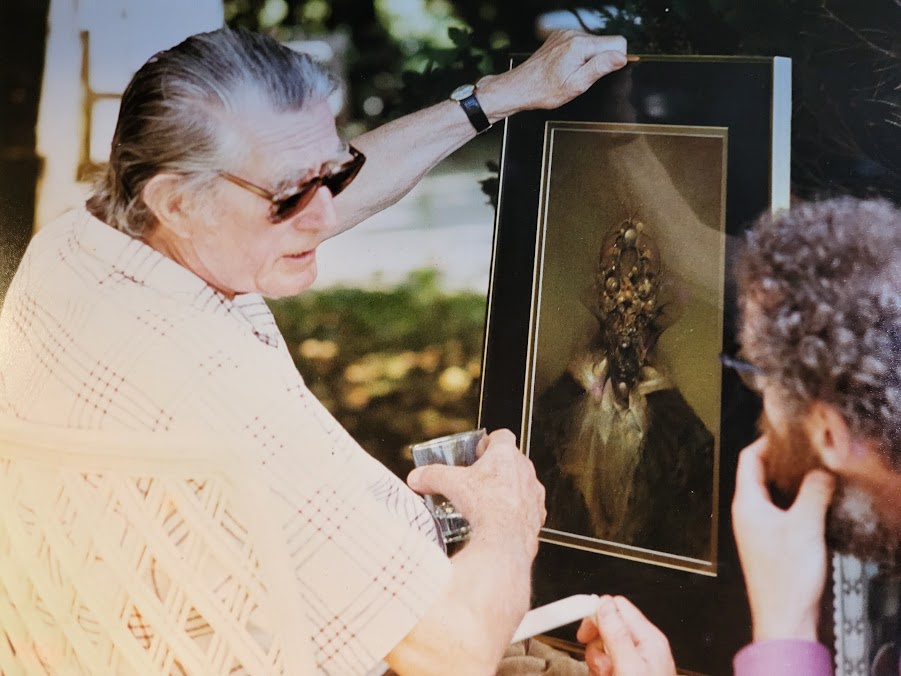
Roland Penrose and Dave D at Farley Farm checking out "The Journeyman" painted by DD in 1977.
Purchased by the Elephant trust, a fund set up by Roland Penrose the Elephant Trust has its origins in a single painting: Max Ernst’s The Elephant Celebes (1921). For almost 50 years this one canvas has been funding artists to produce new work – a lineage which few other artworks can claim.
The work was sold in 1975 by the artist Roland Penrose to fund a trust that would support the needs of emerging artists – a mission that has remained in place to this day. Then as now, the trust was conceived as a place outside of normal funding channels and more directly responsive to the needs of producing new work. The simplicity of this goal has meant that the organisation eschews elaborate funding applications, has a board comprised only of artists and art professionals, and privileges proposals to which the trust can make a real difference.
Roland Penrose and Dave D at Farley Farm
Roland Penrose CBE (14 October 1900 – 23 April 1984) was an English artist, historian and poet. He was a major promoter and collector of modern art and an associate of the surrealists in the United Kingdom
The ICA
After the war, Penrose co-founded the Institute of Contemporary Arts (ICA) in London in 1947.[18] He organised the first two ICA exhibitions: 40 Years of Modern Art,[19] which included many key works of Cubism, and 40,000 Years of Modern Art, which reflected his interest in African sculpture.[20][21] Penrose was a presence at the ICA for 30 years; he produced books on the works of his friends Pablo Picasso,[22] Max Ernst, Joan Miró, Man Ray and Antoni Tàpies. He was also a trustee of the Tate Gallery; he organised a survey of Picasso's work there in 1960 and used his contacts to negotiate purchases of works by Picasso and the Surrealists at discounted prices.