
God the Geometer - Manuscript illustration
"When he established the heavens I was there:
when he set a compass upon the face of the deep:"
Proverbs, Chapter 8 para. 27
So let us begin on earth and travel upwards through the nine concentric spheres of the Ptolemaic system which gave a geometric structure to the celestial world.
Although it is helpful to step forward in time and look at a Medieval version of the universe, consisting of the Four Realms, numerically symbolic in their own right, which were essentially grouped into two sets of two:
Two resided below the moon, or Sublunary: Matter & Nature
and two above the moon, or Translunary: Celestial & Super-celestial
We now put the Sublunary World aside to concentrate on the Celestial but further divide the celestial realm into the 9 spheres of the heavens, the sun, moon, 5 planets, the fixed stars, and the primum mobile:
The Nine Circles of Heaven
Circle 1: The Moon Circle 2: Mercury Circle 3: Venus Circle 4: The Sun Circle 5: Mars Circle 6: Jupiter Circle 7: Saturn Circle 8: The Fixed Stars Circle 9: The Primum Mobile and The Empyrium and we then find ourselves inside the geocentric universe portrayed in this picture by Giovanni di Paolo.
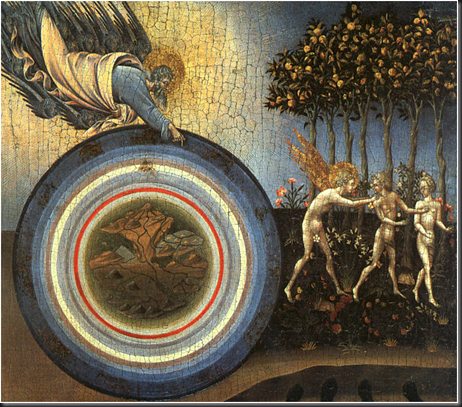
Creation of the World & Expulsion from Paradise by Giovanni di Paolo (1445)
Disassembled, Giovanni di Paolo’s painting shows:
The Earth (in brown) at the centre, shown as a Mappamondo, or world map, surrounded by the three other elements, water, air, and fire, its bright red clearly marks the boundary between the sublunary and translunary realms. Then comes the moon and planets, all blue, except for the Sun, yellow-white, with gilded sunburst, and Mars, in pink, for the red planet. Then the fixed stars with signs of the zodiac, the Primum mobile (the first moved) which regulated the motion of all the spheres beneath it, and the Empyrean heaven, the home of God and the angels.
The number of rings found in pictures of this type, however, can vary from one to the other. For a start, theologians couldn't decide whether the Empyrium occupied a definite sphere, or whether it was infinite and unknowable – a fairly major problem for artists.
In Di Paolo’s rendition he shows no ring for the Empyrium, just a region beyond the last ring, implying that it cannot be contained by a circular boundary.
Yet according to Eustace Mandeville Wetenhall Tillyard OBE, English classical and literary scholar and Master of Jesus College, Cambridge (1945 to 1959), compared to the rest of the Medieval universe, our sublunary realm was not so brilliant. While we may think that earth being at the centre of all this made it special and exalted, we would be wrong and in fact the view is that it was just the opposite.
Listening to Tillyard, which I think I cheerfully could have done all day, at least for a time window, he said;
'. . . far from being dignified . . . the earth in the Ptolemaic system was the cesspool of the universe, the repository of its grossest dregs.. .'
By the 'grossest dregs' he probably meant people, but I am positively entranced by the language the delightful old buffer employed to describe the situation.
The likely source for di Paolo's picture and others in a similar vein was Sacrobosco's Sphaera mundi: a popular source for this fundamental information written in the 13th century and used to teach at universities. It presented an elementary and introductory view of the universe, based on Greek cosmology beneath a patina of Christian spin doctoring.

Illustration from Sacrobosco Sphaera mundi
So we have what, Professor David Edgerton, Hans Rausing Professor of the History of Science and Technology and Professor of Modern British History at Kings College London, refers to as the Geometrization of Heavenly Space. The counterpart of our geometritization of terrestrial space achieved with linear perspective, wherein all receding lines travel neatly and obediently to a vanishing point at infinity. This latter pristinely exacting environment likely part of a world view probably dictated rather than determined by the general conception of an orderly universe that God had created out of chaos, according to the Book of Wisdom (Wisdom of Solomon) included in Jewish, Roman Catholic and Orthodox scriptures, whereby ‘God had arranged all things according to Number, Weight, and Measure.’
More to come methinks as this thread is, given a fair following wind and a firm hand on the tiller, potentially likely to evolve as a combination of mathematically (geometrically) linked celestial themes in Art & Architecture. I think, but then again who knows.
