As an Arabic word, "Islam" means to surrender, to obey, to bow down. As a term "Islam" means accepting what the Prophet (saas) has informed us and surrendering to all of them. Therefore, Islam is surrendered to the souls of Allah and His messengers. In this sense, every believer, Muslim, and every Muslim is a believer.
Allaah says (interpretation of the meaning): "The religion of Allah is surely Islam." (Ali Imran, 19) "I have chosen Islam as your religion." (Al-Maida, 3)
"Repent and turn to your Lord. Surrender to her before you come to torment. Then you will not be helped. " (Az-Zumar, 54)
"Die alone when you are Muslims!" (Al-Baqara, 132 and Ali Imran, 102).
"How can they look for a religion other than God's religion? But all that is in the heavens and the earth, willingly or unwillingly, submit to Him, and to Him they will return. "(Ali Imran, 83)
"Whoever follows a religion other than Islam, it will never be accepted from him, and he will be among the losers in the Hereafter." (Ali Imran, 85)
About Islam religion
-
Redbeck
- Site Admin
- Posts: 2147
- Joined: 19 Dec 2010 15:42
- Location: The Rookery, 3rd Horse Chestnut along, St Johns, Britain. Teacher leave our nuts alone!
- Contact:
Re: About Islam religion
Islamic astronomy comprises the astronomical developments made in the Islamic world, particularly during the Islamic Golden Age (9th–13th centuries), and mostly written down in the Arabic language.
Around the 6th century AD, Europe slumped into what’s referred to as the Dark Ages. This period from around 500 AD until to the 13th century witnessed the suppression of intellectual thought and scholarship around the continent because it was seen as a conflict to the religious views of the Christian church. In other words religion was ruling logical and creative thought processes which should never happen, for example we see the changes taking place in Saudi Arabia as religion becomes increasingly less influential in the running of the country. During this time in Europe the written word became scarcer, and research and observations lapsed into a dormant state.
While Europe was in an intellectual coma, the Islamic empire which stretched from Moorish Spain, to Egypt and even China, was entering a 'Golden Age'. Astronomy was of intense interest to Islamic scholars based in Iran and Iraq, and at the time, around 800 AD, the only astronomical textbook available was Ptolemy’s Almagest, written around 100 AD in Greece. This venerable text is still used as and remains the main point of reference for ancient astronomy in academia to this day. However, Muslim scholars waited 700 years for this fundamental Greek text to be translated into Arabic, and once this had been achieved, they went to work to understand the contents.
Yet, astronomers such as Ibn Yunus from Egypt found faults in Ptolemy’s calculations relative to the movements of the planets and their indivdual eccentricities. Ptolemy attempted to find an explanation as to how these bodies orbited in the sky, including how the Earth moved within these same parameters. Ptolemy calculated that the wobble of the Earth, or precession as we now know it, varied 1 degree every 100 years.
Later, astronomer Ibn Yunus found that Ptolemy was quite wrong and that in fact it was 1 degree every 70 years. However, the cause of this change was not attributed to the Earth’s wobble in the 10th century as it was still believed that Earth was at the centre of the universe. This discovery by Ibn Yunus and others like Ibn al-Shatir changed the landscape of astronomy forever. The heliocentric model eventually proposed by Copernicus in the 16th century was built on this saame body of work.
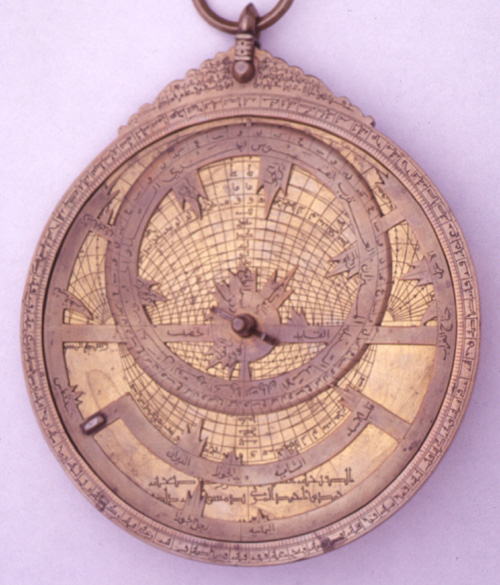
Islamic Astrolabes,


Around the 6th century AD, Europe slumped into what’s referred to as the Dark Ages. This period from around 500 AD until to the 13th century witnessed the suppression of intellectual thought and scholarship around the continent because it was seen as a conflict to the religious views of the Christian church. In other words religion was ruling logical and creative thought processes which should never happen, for example we see the changes taking place in Saudi Arabia as religion becomes increasingly less influential in the running of the country. During this time in Europe the written word became scarcer, and research and observations lapsed into a dormant state.
While Europe was in an intellectual coma, the Islamic empire which stretched from Moorish Spain, to Egypt and even China, was entering a 'Golden Age'. Astronomy was of intense interest to Islamic scholars based in Iran and Iraq, and at the time, around 800 AD, the only astronomical textbook available was Ptolemy’s Almagest, written around 100 AD in Greece. This venerable text is still used as and remains the main point of reference for ancient astronomy in academia to this day. However, Muslim scholars waited 700 years for this fundamental Greek text to be translated into Arabic, and once this had been achieved, they went to work to understand the contents.
Yet, astronomers such as Ibn Yunus from Egypt found faults in Ptolemy’s calculations relative to the movements of the planets and their indivdual eccentricities. Ptolemy attempted to find an explanation as to how these bodies orbited in the sky, including how the Earth moved within these same parameters. Ptolemy calculated that the wobble of the Earth, or precession as we now know it, varied 1 degree every 100 years.
Later, astronomer Ibn Yunus found that Ptolemy was quite wrong and that in fact it was 1 degree every 70 years. However, the cause of this change was not attributed to the Earth’s wobble in the 10th century as it was still believed that Earth was at the centre of the universe. This discovery by Ibn Yunus and others like Ibn al-Shatir changed the landscape of astronomy forever. The heliocentric model eventually proposed by Copernicus in the 16th century was built on this saame body of work.
Islamic Astrolabes,
Who is online
Users browsing this forum: Bing [Bot] and 12 guests