The Merseburg Charms

Click 'The Oracle' title above to enter The Oracle Forum and discuss your quest for answers with kindred spirits. Courtesy costs nothing - if you disagree with someone, disagree politely. Abuse is not tolerated.
Post Reply
Nazheek
Posts: 424
Joined: 30 Nov 2015 18:26
Location: US Southeast
Contact:

The Merseburg Charms

Post by Nazheek »

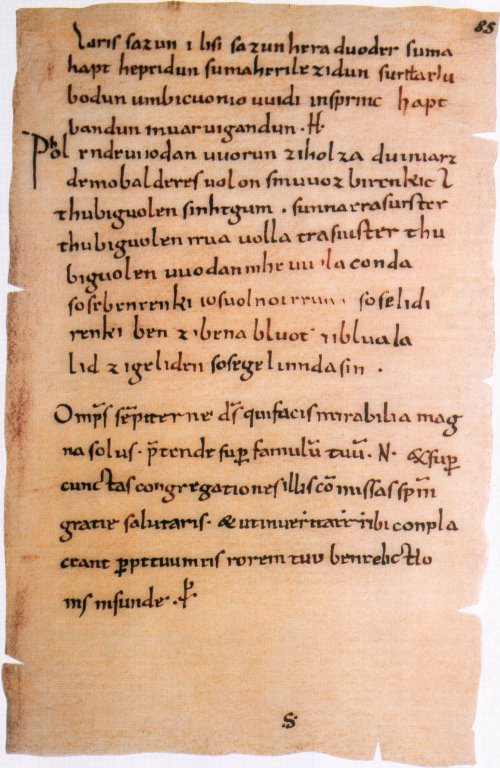
The Merseburg charms are the only piece of Heathenism in the Old High German language to survive. They take the form of two incantations. Discovered by a politician named Georg Waitz, they are from around the ninth century and are in fine condition.

Image

The first among this appears to be an incantation with the goal of freeing oneself

"Eiris sazun idisi, sazun hera duoder;
suma hapt heptidun, suma heri lezidun,
suma clubodun umbi cuoniouuidi:
insprinc haptbandun, inuar uigandun."

This details the escape of captive women.

The second tells the story of a horse whom's foot is sprained, and how the gods were invoked to heal it.

"Eiris sazun idisi, sazun hera duoder;
suma hapt heptidun, suma heri lezidun,
suma clubodun umbi cuoniouuidi:
insprinc haptbandun, inuar uigandun."

Interesting, "uma hapt heptidun, suma heri lezidun,
suma clubodun umbi cuoniouuidi" appears in many incantations throughout history.

A Vedic spell goes

"Let thy marrow come together with marrow, and thy joint together with joint;
together let what of your flesh has fallen apart, together let thy bone grow over.
Let marrow be put together with marrow; let skin grow with skin;
let thy blood, bone grow; let flesh grow with flesh.
Fit thou together hair with hair; fit together skin with skin;
let thy blood, bone grow; put together what is severed,"

Which is a very similar translation to the healing spell's translation.

The Charms are currently held by Christians in Merseburg.
Feel free to send me a PM or an email. Expect faster responses by email.
Redbeck
Site Admin
Posts: 2148
Joined: 19 Dec 2010 15:42
Location: The Rookery, 3rd Horse Chestnut along, St Johns, Britain. Teacher leave our nuts alone!
Contact:

Re: The Merseburg Charms

Post by Redbeck »

Evening Nazheek, thank you for this post, I am too late in acknowledging it really, I read about these charms years and years ago, and truthfully speaking I had completely forgotten about them. Yet, I found this description from somewhere:

The Merseburg charms, also referred to as the Merseburg incantations (Original German: die Merseburger Zaubersprüche) are two medieval magic spells, charms or incantations, written in Old High German. They were discovered in 1841 by German historian and politician, Georg Waitz in a theological manuscript from Fulda, a city in Hesse, Germany. Experts estimate that The Merseburg charms were physically written down in the 9th or 10th century, although speculation remains as to exactly when the incantations were devised and handed down orally before the were committed to manuscript.

The First Charm

Eiris sazun idisi, sazun hera duoder;
suma hapt heptidun, suma heri lezidun,
suma clubodun umbi cuoniouuidi:
insprinc haptbandun, inuar uigandun.


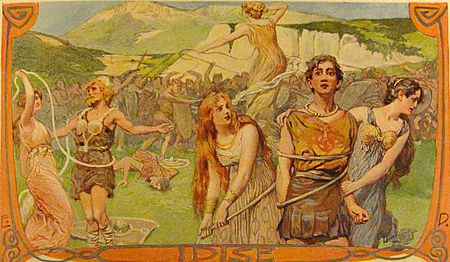
Once sat women,
They sat here, then there.
Some fastened bonds,
Some impeded an army,
Some unravelled fetters:
Escape the bonds,
flee the enemy!

Image

Idise (1905) by Emil Doepler.

The Seccod Charm

Phol ende uuodan uuorun zi holza.
du uuart demo balderes uolon sin uuoz birenkit.
thu biguol en sinthgunt, sunna era suister;
thu biguol en friia, uolla era suister;
thu biguol en uuodan, so he uuola conda:
sose benrenki, sose bluotrenki, sose lidirenki:
ben zi bena, bluot si bluoda,
lid zi geliden, sose gelimida sin!


Phol and Wodan were riding to the woods,
and the foot of Balder's foal was sprained
So Sinthgunt, Sunna's sister, conjured it.
and Frija, Volla's sister, conjured it.
and Wodan conjured it, as well he could:
Like bone-sprain, so blood-sprain,
so joint-sprain:
Bone to bone, blood to blood,
joints to joints, so may they be mended.

Here there are clear references to pagan Norse mythology, Wodan is historically attested as Odin, equally Frija is the cognate of Frigg, also identifiable with Freyja. Balder is undoubtedly Norse origin Baldr. While Phol is definitely the masculine form of Uolla, the context is clear in that it is another name for Balder. Uolla has been regularly linked to Fulla, a minor goddess and a handmaiden of Frigg. Sunna (the sun), a reference much beloved of the site, in Norse mythology is Sól, athough her sister Sinthgunt is not mytholgically attestable.

Image

Wodan Heals Balder's Horse (1905) by Emil Doepler.
Post Reply

Who is online

Users browsing this forum: No registered users and 4 guests