The Fifth Monarchists were one of many Christian faith groups both during and after the English Civil War whose theological beliefs challenged prevailing mainstream ideas on religion. Effectively the text of prophecies contained within Daniel 2 in the Old Testament and underwriting Fifth Monarchy geopolitical theory belief, describes the contents of a prophetic dream by Nebuchadnezzar in which four former empires, divined to be Babylonian, Persian, Grecian and Roman had already flourished and declined as a preamble to the second coming . Therefore the Monarchists' interpretation, was that the final empire would be established by the return of Jesus as King of Kings and Lord of Lords. According to the prophecy, destined to reign on earth with his saints for a thousand years, while the Fifth Monarchists saw themselves as becoming those saints at the start of an imminently dawning millennium.
Prominent Fifth Monarchists included Parliamentarian Major General Thomas Harrison, Christopher Feake, Welsh Nonconformist Puritan preacher Vavasor Powell, John Carew, preacher and physician John Rogers and Robert Blackborne, Secretary of the Admiralty and later of the British East India Company.
Fifth Monarchists believed that the timing of the events of the Interregnum were significant because the calendar year 1666 loomed large on the near horizon. The number 666 had been identified in the Book of Revelation with the ultimate human despot to rule the world, who would be replaced by the Second Coming of the Messiah; this only added to the belief that the Fifth Monarchy was about to begin. Equally symbolic to them was the fact that if Latin Roman numerals were written down in diminishing numerical value sequence, as in MDCLXVI they transcribed as 1666.
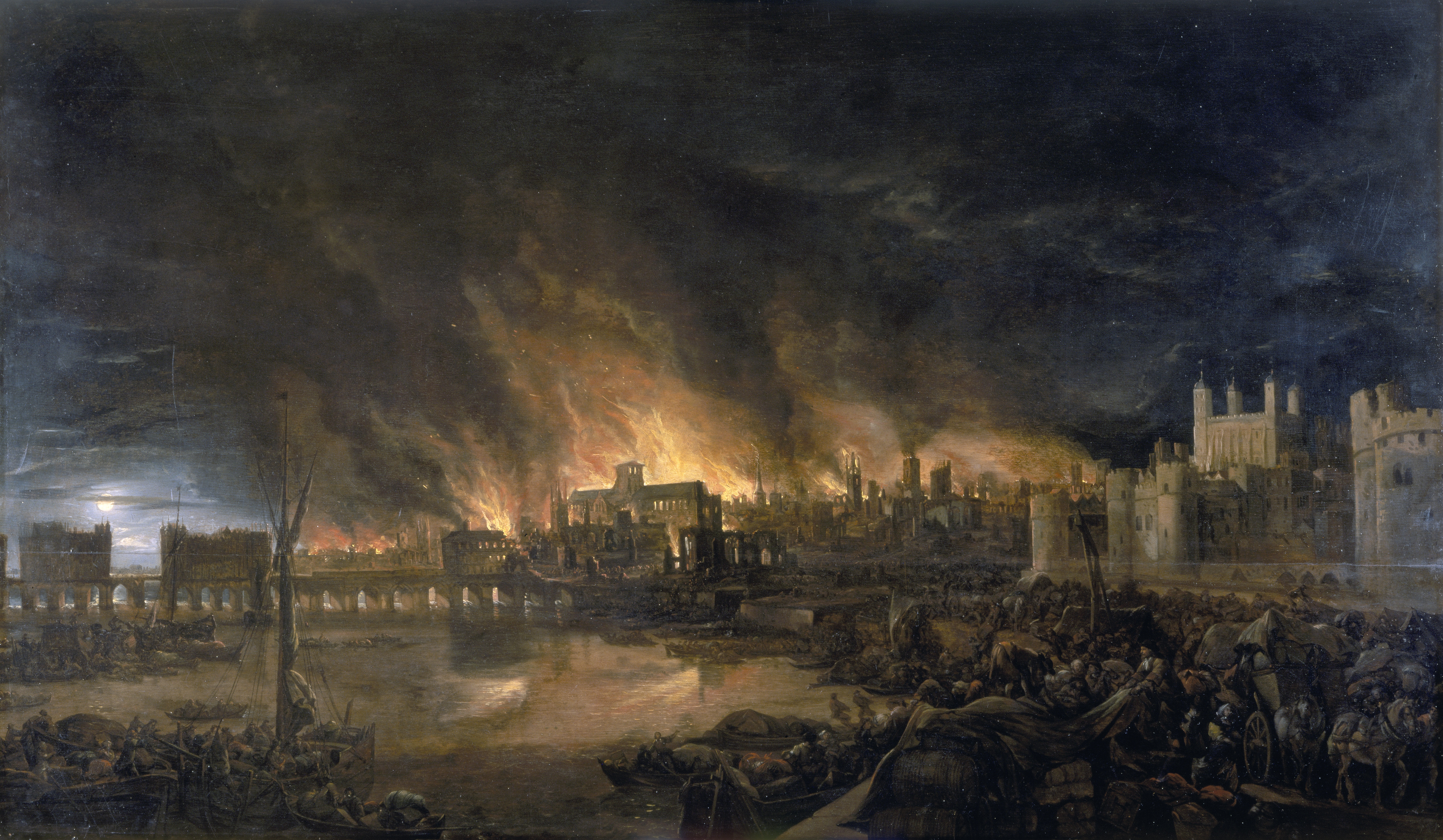
The Great Fire of London, September 1666, which consumed much of the medieval City of London inside the old Roman city wall, including St Paul's Cathedral became a significant threshold (perhaps a hearthstone is more appropriate) for the second coming in the eyes of Fifth Monarchists, a new world arising from the ashes.
The fire gutted threatened but did not reach the aristocratic district of Westminster, Charles II's Palace of Whitehall, and most of the suburban slums. It consumed 13,200 houses and based on the high multiple occupancy of the times is estimated to have destroyed the homes of 70,000 of the City's 80,000 inhabitants along with 87 parish churches besides St Paul's Cathedral, plus most of the buildings of the City authorities.